-
- Art. 3 FC
- Art. 5a FC
- Art. 6 FC
- Art. 10 FC
- Art. 13 FC
- Art. 16 FC
- Art. 17 FC
- Art. 20 FC
- Art. 22 FC
- Art. 26 FC
- Art. 29a FC
- Art. 30 FC
- Art. 31 FC
- Art. 32 FC
- Art. 42 FC
- Art. 43 FC
- Art. 43a FC
- Art. 45 FC
- Art. 51 FC
- Art. 52 FC
- Art. 55 FC
- Art. 56 FC
- Art. 60 FC
- Art. 68 FC
- Art. 69 FC
- Art. 74 FC
- Art. 75b FC
- Art. 77 FC
- Art. 81 FC
- Art. 96 para. 1 FC
- Art. 96 para. 2 lit. a FC
- Art. 110 FC
- Art. 117a FC
- Art. 118 FC
- Art. 119a FC
- Art. 122 FC
- Art. 123a FC
- Art. 123b FC
- Art. 130 FC
- Art. 136 FC
- Art. 164 FC
- Art. 166 FC
- Art. 170 FC
- Art. 176 FC
- Art. 178 FC
- Art. 189 FC
- Art. 191 FC
-
- Art. 11 CO
- Art. 12 CO
- Art. 50 CO
- Art. 51 CO
- Art. 84 CO
- Art. 97 CO
- Art. 98 CO
- Art. 99 CO
- Art. 100 CO
- Art. 143 CO
- Art. 144 CO
- Art. 145 CO
- Art. 146 CO
- Art. 147 CO
- Art. 148 CO
- Art. 149 CO
- Art. 150 CO
- Art. 633 CO
- Art. 701 CO
- Art. 713 CO
- Art. 715 CO
- Art. 715a CO
- Art. 734f CO
- Art. 785 CO
- Art. 786 CO
- Art. 787 CO
- Art. 788 CO
- Art. 808c CO
- Transitional provisions to the revision of the Stock Corporation Act of June 19, 2020
-
- Art. 2 PRA
- Art. 3 PRA
- Art. 4 PRA
- Art. 6 PRA
- Art. 10 PRA
- Art. 10a PRA
- Art. 11 PRA
- Art. 12 PRA
- Art. 13 PRA
- Art. 14 PRA
- Art. 15 PRA
- Art. 16 PRA
- Art. 17 PRA
- Art. 19 PRA
- Art. 20 PRA
- Art. 21 PRA
- Art. 22 PRA
- Art. 23 PRA
- Art. 24 PRA
- Art. 25 PRA
- Art. 26 PRA
- Art. 27 PRA
- Art. 29 PRA
- Art. 30 PRA
- Art. 31 PRA
- Art. 32 PRA
- Art. 32a PRA
- Art. 33 PRA
- Art. 34 PRA
- Art. 35 PRA
- Art. 36 PRA
- Art. 37 PRA
- Art. 38 PRA
- Art. 39 PRA
- Art. 40 PRA
- Art. 41 PRA
- Art. 42 PRA
- Art. 43 PRA
- Art. 44 PRA
- Art. 45 PRA
- Art. 46 PRA
- Art. 47 PRA
- Art. 48 PRA
- Art. 49 PRA
- Art. 50 PRA
- Art. 51 PRA
- Art. 52 PRA
- Art. 53 PRA
- Art. 54 PRA
- Art. 55 PRA
- Art. 56 PRA
- Art. 57 PRA
- Art. 58 PRA
- Art. 59a PRA
- Art. 59b PRA
- Art. 59c PRA
- Art. 60 PRA
- Art. 60a PRA
- Art. 62 PRA
- Art. 63 PRA
- Art. 64 PRA
- Art. 67 PRA
- Art. 67a PRA
- Art. 67b PRA
- Art. 73 PRA
- Art. 73a PRA
- Art. 75 PRA
- Art. 75a PRA
- Art. 76 PRA
- Art. 76a PRA
- Art. 90 PRA
-
- Art. 1 IMAC
- Art. 1a IMAC
- Art. 3 para. 1 and 2 IMAC
- Art. 8 IMAC
- Art. 8a IMAC
- Art. 11b IMAC
- Art. 16 IMAC
- Art. 17 IMAC
- Art. 17a IMAC
- Art. 32 IMAC
- Art. 35 IMAC
- Art. 47 IMAC
- Art. 48 IMAC
- Art. 54 IMAC
- Art. 56 IMAC
- Art. 55a IMAC
- Art. 63 IMAC
- Art. 65 IMAC
- Art. 67 IMAC
- Art. 67a IMAC
- Art. 74 IMAC
- Art. 74a IMAC
- Art. 80 IMAC
- Art. 80a IMAC
- Art. 80b IMAC
- Art. 80c IMAC
- Art. 80d IMAC
- Art. 80h IMAC
- Art. 80k IMAC
-
- Vorb. zu Art. 1 FADP
- Art. 1 FADP
- Art. 2 FADP
- Art. 3 FADP
- Art. 4 FADP
- Art. 5 lit. c FADP
- Art. 5 lit. d FADP
- Art. 5 lit. f und g FADP
- Art. 6 para. 3-5 FADP
- Art. 6 Abs. 6 and 7 FADP
- Art. 7 FADP
- Art. 10 FADP
- Art. 11 FADP
- Art. 12 FADP
- Art. 14 FADP
- Art. 15 FADP
- Art. 18 FADP
- Art. 19 FADP
- Art. 20 FADP
- Art. 21 FADP
- Art. 22 FADP
- Art. 23 FADP
- Art. 25 FADP
- Art. 26 FADP
- Art. 27 FADP
- Art. 28 FADP
- Art. 29 FADP
- Art. 31 para. 2 lit. e FADP
- Art. 33 FADP
- Art. 34 FADP
- Art. 35 FADP
- Art. 38 FADP
- Art. 39 FADP
- Art. 40 FADP
- Art. 41 FADP
- Art. 42 FADP
- Art. 43 FADP
- Art. 44 FADP
- Art. 44a FADP
- Art. 45 FADP
- Art. 46 FADP
- Art. 47 FADP
- Art. 47a FADP
- Art. 48 FADP
- Art. 49 FADP
- Art. 50 FADP
- Art. 51 FADP
- Art. 52 FADP
- Art. 54 FADP
- Art. 55 FADP
- Art. 57 FADP
- Art. 58 FADP
- Art. 60 FADP
- Art. 61 FADP
- Art. 62 FADP
- Art. 63 FADP
- Art. 64 FADP
- Art. 65 FADP
- Art. 66 FADP
- Art. 67 FADP
- Art. 69 FADP
- Art. 72 FADP
- Art. 72a FADP
-
- Art. 1 CCC (Convention on Cybercrime)
- Art. 2 CCC (Convention on Cybercrime)
- Art. 3 CCC (Convention on Cybercrime)
- Art. 4 CCC (Convention on Cybercrime)
- Art. 5 CCC (Convention on Cybercrime)
- Art. 6 CCC (Convention on Cybercrime)
- Art. 7 CCC (Convention on Cybercrime)
- Art. 8 CCC (Convention on Cybercrime)
- Art. 9 CCC (Convention on Cybercrime)
- Art. 11 CCC (Convention on Cybercrime)
- Art. 12 CCC (Convention on Cybercrime)
- Art. 16 CCC (Convention on Cybercrime)
- Art. 18 CCC (Convention on Cybercrime)
- Art. 25 CCC (Convention on Cybercrime)
- Art. 27 CCC (Convention on Cybercrime)
- Art. 28 CCC (Convention on Cybercrime)
- Art. 29 CCC (Convention on Cybercrime)
- Art. 32 CCC (Convention on Cybercrime)
- Art. 33 CCC (Convention on Cybercrime)
- Art. 34 CCC (Convention on Cybercrime)
-
- Art. 2 para. 1 AMLA
- Art. 2a para. 1-2 and 4-5 AMLA
- Art. 2 para. 2 AMLA
- Art. 2 para. 3 AMLA
- Art. 3 AMLA
- Art. 7 AMLA
- Art. 7a AMLA
- Art. 8 AMLA
- Art. 8a AMLA
- Art. 9 AMLA
- Art. 11 AMLA
- Art. 14 AMLA
- Art. 15 AMLA
- Art. 20 AMLA
- Art. 23 AMLA
- Art. 24 AMLA
- Art. 24a AMLA
- Art. 25 AMLA
- Art. 26 AMLA
- Art. 26a AMLA
- Art. 27 AMLA
- Art. 28 AMLA
- Art. 29 AMLA
- Art. 29a AMLA
- Art. 29b AMLA
- Art. 30 AMLA
- Art. 31 AMLA
- Art. 31a AMLA
- Art. 32 AMLA
- Art. 33 AMLA
- Art. 34 AMLA
- Art. 38 AMLA
FEDERAL CONSTITUTION
FEDERAL ACT ON DIRECT FEDERAL TAX
MEDICAL DEVICES ORDINANCE
CODE OF OBLIGATIONS
FEDERAL LAW ON PRIVATE INTERNATIONAL LAW
LUGANO CONVENTION
CODE OF CRIMINAL PROCEDURE
CIVIL PROCEDURE CODE
FEDERAL ACT ON POLITICAL RIGHTS
CIVIL CODE
FEDERAL ACT ON CARTELS AND OTHER RESTRAINTS OF COMPETITION
FEDERAL ACT ON INTERNATIONAL MUTUAL ASSISTANCE IN CRIMINAL MATTERS
DEBT ENFORCEMENT AND BANKRUPTCY ACT
FEDERAL ACT ON DATA PROTECTION
CRIMINAL CODE
CYBERCRIME CONVENTION
COMMERCIAL REGISTER ORDINANCE
FEDERAL ACT ON COMBATING MONEY LAUNDERING AND TERRORIST FINANCING
FREEDOM OF INFORMATION ACT
FEDERAL ACT ON THE INTERNATIONAL TRANSFER OF CULTURAL PROPERTY
FEDERAL ACT ON MEDICINAL PRODUCTS AND MEDICAL DEVICES
TAX HARMONISATION ACT
BANKING ACT
- I. Basis
- II. Scope
- III. Exceptions
- IV. List of criminal offenses (Art. 2 para. 3 lit. a–g AMLA)
- V. General clause
- VI. Professionalism
- VII. Consequences of the obligation to comply
- Bibliography
- Materials
I. Basis
A. Purpose and relationship between paragraphs 2 and 3
1 According to Art. 2 para. 1 AMLA, the Anti-Money Laundering Act applies primarily (lit. a) to financial intermediaries and secondarily (lit. b) to natural and legal persons who trade in goods on a commercial basis and accept cash in the process (dealers). The term “financial intermediaries” encompasses all natural and legal persons described in paragraphs 2 and 3 of the Act.
2 The list in Art. 2 para. 2 AMLA initially refers exclusively to institutions that are directly or indirectly supervised by FINMA as financial intermediaries, whereby reference is made to the respective special laws for their definition.
3 However, since institutions without FINMA authorization can also engage in financial intermediation activities that are (also) “particularly susceptible to money laundering” but “where the risk of abuse for money laundering purposes is less obvious,” the so-called parabanking sector has been made subject to money laundering legislation under the supervision of self-regulatory organizations approved by FINMA in accordance with Art. 24 para. 1 AMLA. The activities covered correspond to the scope of Art. 305ter para. 1 of the Swiss CC. In addition to the general clause, Art. 2 para. 3 lit. a–g AMLA lists a catalog of criminal offenses. While Art. 2 para. 2 AMLA thus refers to the respective license category, Art. 2 para. 3 AMLA refers specifically to the activities covered. How these activities are classified under contract law is not decisive.
4 Para. 3 is a subsidiary final provision in relation to para. 2. This means that the same financial intermediary cannot be subject to both para. 2 and para. 3 at the same time and that para. 3 can only apply if a financial intermediary is not already subject to para. 2 of the AMLA.
B. Regulatory cascade
5 Based on Art. 41 para. 1 AMLA, the Federal Council specifies the scope of application of Art. 2 para. 3 AMLA in Art. 2 ff. of the Ordinance on Combating Money Laundering and Terrorist Financing (Money Laundering Ordinance, AMLO) of November 11, 2015.
6 In its Circular 2011/1 “Activities as a financial intermediary under the AMLO – Explanatory notes on the Anti-Money Laundering Ordinance (AMLO)”, FINMA set out its practice for interpreting money laundering legislation, including examples of activities that are subject to the Anti-Money Laundering Act. The FINMA circular has no independent regulatory effect, but is very relevant in practice as a guideline.
7 FINMA Circular 2011/1 replaces the subordinate commentary of the former Money Laundering Control Authority dated October 29, 2008 (UK Kst. AMLA), which continues to serve as an interpretative aid in doctrine and practice due to its more detailed explanations.
C. Structure of the provision
8 Art. 2 para. 3 AMLA contains a general clause with an abstract definition. According to this, persons who “accept or hold assets of third parties on a commercial basis or participate in their investment or transfer” are initially considered financial intermediaries.
9 The paragraph then contains a specific list of catalogued circumstances, which is not exhaustive according to the connecting term “in particular.” Here, too, the catalogued circumstances take precedence over the general clause in the sense of a lex specialis. It must therefore first be examined whether a circumstance under Art. 2 para. 3 lit. a–g AMLA exists. If this is not the case, the second step is to examine whether the general clause could be fulfilled. One argument in favor of this approach is that some of the catalog cases impose special requirements on professional conduct.
10 Both the law and the ordinance contain exemptions that must be observed. Art. 2 para. 4 AMLA excludes certain activities and institutions from the scope of the AMLA. Art. 2 para. 2 AMLO contains specific exemptions that refer to Art. 2 para. 3 AMLA. These exceptions apply to both the general clause and the special circumstances.
11 The exemplary list of activities in Art. 2 para. 3 AMLA should not obscure the fact that some of the cases listed in the catalog go beyond the scope of the general clause. Accordingly, not every person who meets the criteria of a case listed in the catalog necessarily also meets those of the general clause. Rather, the catalog contains separate special circumstances that extend the scope of application of Art. 2 para. 3 AMLA and have an independent meaning. From a legal perspective and for better understanding, it would be desirable to indicate this accordingly in the wording of the law.
D. Interpretation of the provision
12 The interpretation of the AMLA by the AMLA supervisory authority was based on the purpose of the AMLA (Art. 1) with corresponding materials in a form that deliberately aimed to apply the AMLA only to persons active in the financial sector. Accordingly, only activities attributable to the financial sector, including those listed in the catalog in Art. 2 para. 3 lit. a–g AMLA, should be subject to Art. 2 para. 3 AMLA. This catalog should form the “starting point for the interpretation of the general clause.” Activities that are comparable or very similar to those listed in the catalog should be examined on a case-by-case basis and, if necessary, be subject to the AMLA via the general clause. Other activities such as real estate, antiques, or art trading are expressly excluded. These findings remain valid even though the scope has been extended to include trading since 2016 and, according to the ongoing revision of the law, will also include consulting services outside of financial intermediation in the future. Art. 2 para. 3 AMLA remains reserved even with the latest revision of financial intermediation and is clearly distinguished from other services.
13 The general clause of Art. 2 para. 3 AMLA is formulated in abstract and open terms in order to subject activities that are attractive for money laundering and are neutral in terms of technology and innovation to the due diligence and reporting obligations of the AMLA. New forms of financial intermediation should not have to be regulated retrospectively. According to the case law of the Federal Supreme Court, the interpretation of subordination must therefore be handled restrictively. The “regulatory technique used, which merely describes the group of financial intermediaries in an open and exemplary manner, requires that, in addition to the wording, the meaning and purpose of the norm be taken into account more strongly in its interpretation.” In legal doctrine, this consideration is interpreted to mean that the application of money laundering regulations is only justified in cases where there are activities and circumstances that pose a money laundering risk. However, if such a risk is only low, the scope of the due diligence obligations should also be adjusted accordingly. This approach is reflected in particular in the simplified due diligence obligations under the GwV-FINMA.
14 The Federal Administrative Court has clarified that it is not the intention of the AMLA or the AMLO to require proof or justification of a specific money laundering risk in addition to the legally defined elements of the offense in order to be subject to the law. If an activity meets the legal criteria, it is justified that it is subject to the law without further proof of risk. This is appropriate because the legislator has only included circumstances with an inherent money laundering risk in the law, which is why a further risk assessment by the authorities applying the law is not necessary.
E. Recommended assessment method
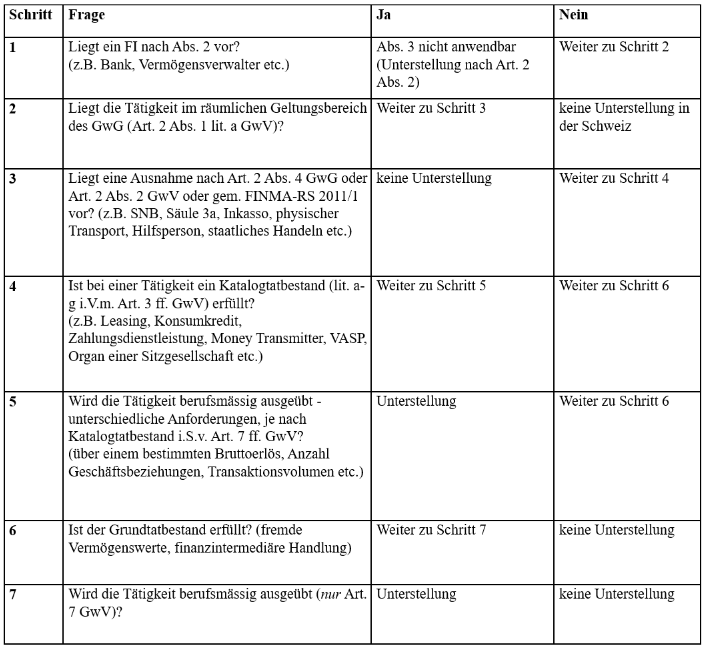
15 The following assessment scheme can be used to determine whether an activity is subject to the AMLA:
II. Scope
A. Geographical
16 In contrast to financial intermediaries under Art. 2 para. 2 AMLA, the geographical scope of financial intermediaries under Art. 2 para. 3 AMLA is expressly regulated in the Anti-Money Laundering Ordinance (AMLO). According to Art. 2 para. 1 lit. a AMLO, the AMLA applies to financial intermediaries who actually operate in Switzerland or from Switzerland.
17 According to FINMA practice, a financial intermediary operates in Switzerland or from Switzerland if it has its registered office in Switzerland or is entered in the commercial register (formal establishment) or if it employs persons in Switzerland who permanently carry out or conclude financial intermediation activities for it in Switzerland or from Switzerland or who can legally oblige it to do so (de facto branch). The geographical scope of the AMLA is therefore determined by the place where the financial intermediation activity is predominantly carried out.
18 In the case of a formal establishment or branch office, the geographical reference point is the place of residence (for natural persons/sole proprietorships) or the registered office (for legal entities) as the formal center of activity. A company with its registered office in Switzerland is therefore subject to the AMLA, even if it only has a C/O address here and both its actual management and the focus of its operational financial intermediation activities are located abroad.
19 Persons who permanently support the foreign financial intermediary in carrying out significant parts of its financial intermediation activities in Switzerland or from Switzerland fall under the category of de facto branches, but not those constellations in which only the customer has a connection to Switzerland. Accordingly, branches of companies that are incorporated under foreign law and have their headquarters abroad, but whose financial intermediation activities are mainly carried out from Switzerland, are subject to regulation. An activity is carried out from Switzerland if, for example, the contractual relationship with the client is managed by the financial intermediary in Switzerland, even if the transactions are executed by the branch abroad.
20 According to FINMA practice, subordination under the AMLA requires a certain degree of permanence of the activity in Switzerland, while purely temporary activities are not considered permanent. The element of permanence is not defined in more detail in FINMA Circular 2011/1 and requires a case-by-case assessment. The criteria used in doctrine are the absolute duration of the activity, the regularity of presence, the type of financial intermediary activity, and the mechanism for exercising physical presence.
21 The personal connection implies a distinction from a purely mechanical connection. A server or purely online services in Switzerland therefore do not constitute an activity relevant to the AMLA. As long as a financial intermediary in Switzerland has staff who merely acquire customers and maintain customer relationships, but in no way commits the financial intermediary, i.e., does not conclude contracts on behalf of the represented party and does not carry out financial intermediation transactions or essential components of such transactions, there is no physical presence in Switzerland within the meaning of Art. 2 para. 1 lit. a AMLO. Purely administrative or technical support therefore does not fall within the scope of the AMLA.
22 In the case of financial intermediaries domiciled or headquartered abroad, as with financial intermediaries headquartered in Switzerland, it must be examined on a case-by-case basis whether their activities in Switzerland meet the requirements for professional activity as a financial intermediary in accordance with Art. 7 AMLO. If this is the case, they are subject to the AMLA. The decisive factor for subordination is the activity actually carried out in Switzerland.
B. Personal and factual
23 Anyone who actually carries out the financial intermediary activities defined in Art. 2 para. 3 AMLA is personally subject to the AMLA. A person is only subject to the AMLA in relation to these activities. Accordingly, the due diligence obligations of the AMLA must only be observed in business relationships that are related to financial intermediary activities.
24 It is conceivable that a supervised activity may be carried out by several persons. In such a case, only the joint action of all persons fulfills the criteria of Art. 2 para. 3 AMLA. In such cases, all persons involved are considered financial intermediaries within the meaning of para. 3.
25 The financial intermediary may be a natural or legal person. The following applies to partnerships: If activities relevant to supervision are carried out by a general partnership or a limited partnership, the partnership itself is a financial intermediary. If they are the subject of a simple partnership, each partner individually becomes a financial intermediary. In the latter case, the provisions of the partnership agreement are decisive for practical implementation.
26 The decisive factor for subordination is the exercise of the activity described in Art. 2 para. 3 AMLA and commented on below. Finally, it should be noted that even financial intermediation activities that meet the criteria only fall within the material scope of the AMLA if the requirement of commercial practice set out in Chapter VI is met and none of the exceptions described in Chapter III apply.
III. Exceptions
A. General
27 In the present case, a distinction must be made between exceptions under the law, under the ordinance, and under FINMA practice, whereby these are not (only), as might be expected, uniformly defined in accordance with the regulatory cascade, but represent different types of exceptions.
28 Art. 2 para. 4 AMLA provides for general exceptions to the registration requirement for institutions and activities that are considered financial intermediation but are not subject to registration due to the absence of money laundering risk.
29 Art. 2 para. 2 AMLO lists specific activities within the financial sector that are not classified as financial intermediation. FINMA has clarified these exemptions in a circular (see III.B. below).
30 Art. 2 para. 2 lit. b AMLO also provides for exceptions for auxiliary persons who carry out financial intermediation activities but are already covered by the client and therefore do not require separate supervision (see III.C. below).
31 In addition, in its practice, FINMA provides for financial intermediation activities in the form of (state) sovereign activities as a further exception to the obligation to comply (see III.D. below).
32 With regard to the list of criminal offenses in Art. 2 para. 3 lit. a–g AMLA, further information that could be described as “exceptions” can be found in Art. 3 ff. AMLO. For example, Art. 3 AMLO lists a catalog of credit relationships that are not to be understood as credit transactions within the meaning of the AMLA. In the present case, such exceptions are examined in the context of the positive elements of the offense (see Chapter IV.B.7.). The absence of a professional activity could also be considered an “exception” (Art. 7 ff. AMLO). In the present case, however, this is also understood as a positive criterion and is therefore examined separately in Chapter VI. The same applies to the “exception” already outlined above, namely the absence of a connection to the geographical scope of Switzerland in accordance with Art. 2 para. 1 lit. a AMLA (see Chapter II.F.). The absence of a connection to the financial sector is also not considered an exception, but must be examined as a positive prerequisite in the general clause (see Chapter V.C.).
B. Non-regulated financial intermediaries
33 According to Art. 2 para. 2 and para. 3 AMLA, institutions whose activities are unlikely to be abused for money laundering would also be subject to the AMLA. The law provides for general exceptions to the obligation to comply in Art. 2 para. 4 AMLA.
C. No financial intermediation activities
1. Physical transport and storage
34 According to Art. 2 para. 2 lit. a no. 1 AMLO, persons who are engaged in the purely physical transport or purely physical storage of assets are not considered financial intermediaries. This refers to the transport of assets from one place to another and the purely physical storage of assets. The custody of securities is expressly reserved (Art. 6 para. 1 lit. c AMLO).
2. Debt collection
35 Debt collection pursuant to Art. 2 para. 2 lit. a no. 2 AMLO is also not considered financial intermediation. This is the case when a person collects a due claim on behalf of a creditor. The agent acts either as the direct representative of the creditor or in their own name vis-à-vis the debtor after the claims have been transferred to them by the creditor on a fiduciary basis. The decisive factor is that the agent has carried out the transfer on behalf of the creditor, which must be determined on the basis of circumstantial evidence. As a rule, the service is remunerated by the client.
36 Debt collection can also be considered to have taken place if the agent acts within a closed circle of recipients of goods or services. The purpose of the assignment is to ensure the smooth processing and simplification of payments to the supplier of the goods or services.
37 If the agent only has a contractual relationship with the creditor of the claim and acts on their behalf, this is usually a debt collection order, which does not constitute a financial intermediation activity. However, if the assets thus received are not forwarded to the creditor itself but to a third party in accordance with the creditor's instructions, this forwarding in turn constitutes a financial intermediation activity, whereby the party that previously collected the claim then acts as a financial intermediary between the creditor and the third party.
38 All due diligence obligations under the AMLA are linked to a contractual customer relationship. However, the (main) customer of a debt collection agency is always the creditor and never the debtor. If there is no contractual relationship between the debt collection agency and the debtor, the flow of money is considered debt collection, which is not subject to the AMLA. In this sense, debt collection activities on behalf of the creditor are excluded from the scope of the AMLA, as the debtor from whom the assets originate is not usually a contractual partner of the agent and therefore cannot be identified.
39 Thus, a property manager who, in the course of normal property management, receives amounts on behalf of, at the instruction of, and for the account of the property owner is not a financial intermediary within the meaning of the AMLA. If a real estate agent collects the purchase price from the buyer on behalf of the seller and is remunerated by the seller, this is also a collection activity that is not subject to the AMLA.
40 If the operator of a crowdfunding platform collects due support contributions on behalf of borrowers, this does not constitute a collection activity within the meaning of the AMLA. The same applies to a company in the field of e-commerce or the development and sale of software solutions for payments via the Internet, mobile phones, or similar, which additionally collects due receivables on behalf of the creditor and forwards them to the latter. In some cases, telecommunications providers offer, in addition to telecommunications services, the option of purchasing other services and goods and paying for them via mobile phone. However, if the rights and obligations of the contracting parties with regard to the payment of goods and services are regulated, such a contractual relationship differs from a debt collection order, as a contractual regulation of the payment terms is atypical for debt collection activities. The close contractual relationship with the customer with regard to the terms of payment cannot be limited to a pure debt collection activity by the telecommunications company. In addition, the customer can usually decide whether to pay the provider of value-added services in cash, by credit card, by Maestro card, or by postpaid or prepaid. In such cases, the client for the transfer is therefore the debtor of the service and not the creditor. Without collection activities, such offers are therefore considered to be presumed payment services. When purchasing digital content, however, the question arises as to whether this is an ancillary service.
41 In connection with the operation of an internet platform, e.g., for the purchase, sale, rental, or exchange of services and products, goods, everyday items, etc., there may be indications of a collection activity in the above sense if (a) the payment processor only has a contractual relationship with the creditor; (b) in most cases, the payment processor charges the creditor a fee for providing the service; (c) the economic interest in the payment flow lies mainly with the creditor; (d) the relationship between the payment processor and the debtor is limited to the collection of the claim due, with no further rights and obligations existing or these serving only to ensure the debtor's confidence in the proper processing of payments and the smooth functioning of the platform. The following factors argue against debt collection activities (a) The debtor has an e-account on the payment processor's internet platform, to which they can add credit at will and from which the amount owed is debited when a service is used, or (b) payment via the payment processing system in question is only one of several payment options, and the debtor themselves becomes the principal when they choose a particular payment method. Since such platforms come in many different forms, it is not possible to give a general answer to the question of whether a platform is subject to the AMLA.
3. Ancillary transfer
42 According to Art. 2 para. 2 lit. a no. 3 AMLO, the transfer of assets as an ancillary service to a main contractual service is not subject to the AMLA.
43 According to FINMA practice, four criteria must be cumulatively met in order for a ancillary service to be assumed:
It is essentially an ancillary service that is part of a contractual relationship that is not attributable to the financial sector;
the contracting party providing the main service also provides the ancillary service;
This ancillary service is of secondary importance in relation to the main service, which can generally be assumed if no additional remuneration is charged for the ancillary service apart from the cost-covering expenses.
The ancillary service is closely related to the main service, so that the provision of the main service without the provision of the ancillary financial intermediation service would entail particular difficulties for the contracting parties.
44 FINMA cites as a typical example the case in which a retirement and nursing home, in addition to the contractual main service, pays for goods or services from third parties on behalf of its customers from a deposit previously set up for this purpose. If visitors to a festival can use a chip to top up their festival wristband with credit (up to a certain maximum amount) in order to purchase goods at stands, with the remaining credit being transferred back to the visitors at the end of the event, this may also constitute an ancillary service that is not subject to supervision. The transfer of assets for digital content (e-newspapers, online games, or video-on-demand) by a telecommunications provider may also be an ancillary service. The ancillary service consists of providing billing options to service operators at the expense of the users of the services. In addition, the provision of billing options indirectly supports the distribution of digital content. As a rule, there is a close factual link between the main service and the ancillary service. However, in the case of value-added services based on physical products/goods (purchases), there is no ancillary service. The purchase of physical products/goods has no close factual link with the telecommunications services to be provided. Furthermore, the provision of the main service without the provision of the supplementary financial intermediation service does not pose any particular difficulties for the contracting parties, as the service user can switch to alternative payment options.
45 The execution of payment orders by accountants in addition to accounting services is generally not considered ancillary. Classifying such payment transactions as ancillary services would contradict the spirit and purpose of Art. 4 para. 1 lit. a AMLO and mean that in the case of a power of attorney for a bank account and the execution of fiduciary or bookkeeping accounting, the AMLA would no longer apply. This is precisely not the intention of the legislator.
4. Pillar 3a
46 According to Art. 2 para. 2 lit. a No. 4 AMLO, the operation of pillar 3a pension funds by bank foundations or insurance companies does not constitute financial intermediation. Since the assets in pillar 3a pension funds are generally tied up for the long term and the amount of the payments and their tax exemption are limited by law, this activity is not considered particularly susceptible to money laundering.
47 While insurance policies are reviewed by FINMA and insurance companies are subject to FINMA supervision, bank foundations are subject to the cantonal BVG supervisory authorities. The bank foundation must manage the pension assets at a bank supervised by FINMA (account solution) or through its intermediary (securities account). This exception thus prevents multiple supervision and takes into account the principle of proportionality.
5. Services within the group
48 According to Art. 2 para. 2 lit. a No. 5 AMLA, the provision of services between group companies does not constitute financial intermediation either. In this context, the group is considered an economic unit of companies within the meaning of the AMLA if one company directly or indirectly holds more than half of the votes or capital of the other company or otherwise controls it. A group company that performs cash management or treasury functions within an industrial or commercial enterprise is therefore not a financial intermediary within the meaning of the AMLA. The regulation also applies to structures that are not managed by a legal entity but by a natural person.
49 However, the obligations under money laundering law do not apply to the activities of a supervised financial intermediary which, due to the group exemption within the meaning of Art. 2 para. 2 lit. a No. 5 AMLO, would not in themselves lead to supervision as a financial intermediary under the AMLA. It should also be noted that the issuance of means of payment that can be redeemed by customers at one or more group companies is subject to Art. 2 para. 3 lit. b AMLA.
D. Auxiliary persons
50 According to Art. 2 para. 2 lit. b AMLO, auxiliary persons of financial intermediaries that are licensed in Switzerland or affiliated with a self-regulatory organization (SROs) are considered to be covered by their license/SRO membership if the requirements under no. 1–6 are met. This exception therefore does not depend on the type of activity, but on the fact that the auxiliary persons are already subject to due diligence obligations through their clients. For this exception to apply, the auxiliary persons must:
be carefully selected by the financial intermediary and be subject to its instructions and control (No. 1);
be included in the financial intermediary's organizational measures and receive appropriate training and continuing education (No. 2);
act exclusively on behalf of and for the account of the financial intermediary (No. 3);
be remunerated by the financial intermediary and not by the end customers (No. 4);
in the case of money or value transfer transactions, they must work exclusively for a single licensed financial intermediary or a financial intermediary affiliated with an SRO (“exclusivity clause,” No. 5);
they must have concluded a written agreement with the financial intermediary regarding compliance with the above requirements (No. 6).
51 The financial intermediary that engages the auxiliary person remains responsible under supervisory law for compliance with the due diligence obligations under the AMLA. With the exception of money or value transfers, auxiliary persons may work for several financial intermediaries that are licensed or affiliated with SROs. The latter exception primarily concerns money transfer service providers. In practice, individuals act as auxiliary persons for the responsible financial intermediary in the day-to-day business of money transfer service providers. It is the responsibility of the financial intermediary to ensure that there is an exclusive partnership with the auxiliary persons.
52 One of the prerequisites for the activity of the auxiliary person not to be considered independent financial intermediation is that they act exclusively in the name and on behalf of the financial intermediary (Art. 2 para. 2 lit. b no. 3 AMLO). In contrast, the activity as an organ can only be carried out in its own name. Subsidiaries of financial intermediaries cannot claim the status of an auxiliary person for themselves.
E. State action
53 According to FINMA practice, state action is not subject to the AMLA if it is carried out within the scope of sovereignty, even if the activity itself would be classified as financial intermediation. It must be examined in each individual case whether the activity is carried out within the scope of state sovereignty or not. Indications of a sovereign activity that is not subject to the AMLA include an explicit legal basis, a relationship of subordination, a public task, or the supervisory authority of a higher-level authority.
54 The state is therefore only subject to the AMLA when it acts within the scope of its non-sovereign activities. Since the fulfillment of sovereign tasks can also be transferred to private individuals, it is irrelevant from a money laundering law perspective in what “form” or organizational structure state action takes place and whether the legal relationships in question are to be classified as private law or administrative law contracts. The decisive factor is the criterion of sovereignty, which must be examined on the basis of the criteria described above.
55 According to FINMA practice, debt collection and bankruptcy offices, liquidators, guardians, pension fund administrators, estate administrators, and executors are not financial intermediaries. However, the latter two are subject to the AMLA if they provide financial intermediary services outside the scope of their mandate, for example in connection with their involvement in the distribution of an estate.
IV. List of criminal offenses (Art. 2 para. 3 lit. a–g AMLA)
A. Introduction
56 Despite the use of the term “in particular,” the list of criminal offenses in Art. 2 para. 3 lit. a–g AMLA in some cases goes beyond the general clause in Art. 2 para. 3 and, as the respective lex specialis, takes precedence over it. The list is therefore not exhaustive.
57 Since its introduction, the provision has been revised several times. For example, with effect from January 1, 2006, the Investment Fund Act (IFG) removed the supervisory requirement for investment fund distributors under letter d due to the lack of money laundering risk. The most significant change occurred with the introduction of the FinIA on January 1, 2020, which made asset management subsumed under letter e subject to a licensing requirement and moved asset managers and trustees as financial intermediaries subject to special legislation to Art. 2 para. 2 lit. abis AMLA. This also repealed letter e. However, due to the different thresholds for professional activity in the AMLA and the FinIA, asset managers and trustees who are not subject to the licensing requirement under the FinIA may still fall within the scope of the AMLA via the general clause or via Art. 2 para. 3 letters a–g AMLA letters f or g.
58 Art. 3 ff. AMLO specifies and, in some cases, restricts the list of criminal offenses, whereby it should be noted that Art. 4 AMLO in particular has undergone significant changes in 2021 due to technological developments in the area of payment transactions.
B. Credit business (lit. a)
1. General
59 According to Art. 2 para. 3 lit. a AMLA, persons are considered financial intermediaries if they conduct credit transactions and are not already subject to the special legal supervision of Art. 2 para. 2 AMLA (e.g., as a bank). Examples of this are consumer or mortgage loans, factoring, trade financing, and finance leasing. The provision covers activities that are similar to banking business but do not involve the acceptance of public funds and where refinancing is carried out to a significant extent by the group.
60 Art. 3 AMLO does not specify these activities in a positive sense, but by means of a negative list of activities that are expressly not considered credit transactions. For its part, FINMA specifies the negative list in the GwV-FINMA in its Circular 2011/1 and also sets out its practice for defining cash and consumer loans as well as trade financing, classifying transactions according to their purpose rather than the type of loan.
61 According to prevailing opinion, the term “loan” is interpreted broadly and functionally with reference to international guidelines and materials. In a credit transaction, the lender undertakes to grant the borrower a monetary advantage, and the borrower undertakes to pay interest and repay the debt. This includes all transactions that have such financing as their purpose, are assigned to the financial sector, are carried out professionally, and do not fall under the exceptions. Traditionally, the term “credit” is also understood to mean a loan. In the case of a credit, the lender sets a limit within which the borrower can make withdrawals. In the case of a loan, the lender makes the entire loan amount available to the borrower from the outset, in accordance with the legal definition in Art. 312 of the Swiss Code of Obligations. According to FINMA practice, the term covers any transfer of money to a borrower in return for the borrower's obligation to repay the amount received and pay interest on it.
62 Legal scholars disagree on whether the credit business clarifies or expands the general clause. In any case, the money laundering risk of the credit business is unanimously seen in the assumption of interest and principal payments and is generally considered to be rather low. The specific risk is that assets from predicate offenses will be used to repay loans. There are a number of known cases in which funds from drug trafficking and fraud have been laundered through loans. However, the risk of terrorist financing through the misuse of loans is considered to be significantly greater. Providers of consumer loans are particularly at risk in this regard.
63 No money flows when a settlement is made. Accordingly, there is no possibility of using criminally acquired funds to repay loans. The risk of money laundering, which is why credit transactions are subject to the AMLA, cannot therefore arise in the first place. Although there is a flow of payments, the situation is comparable to unregulated debt collection.
64 The designation and categorization of credit transactions in the law, the ordinance, and the FINMA circular is inconsistent. The following therefore only deals with the types of credit mentioned as examples in the law that need to be discussed in practice.
2. Mortgage loans and other cash loans
65 Mortgage loans (lit. a) are defined as financing transactions for the acquisition and use of real estate or the construction or renovation of buildings, whereby the loan is secured by real estate.
66 According to FINMA practice, mortgage loans – in addition to overdraft facilities, bill discounting, Lombard loans, and long-term loans such as participation loans and subordinated loans – fall under the category of cash loans. It is irrelevant whether the loans are secured by collateral or other means. Pawnshops that grant loans against collateral are subject to the AMLA.
67 Crowdfunding – in particular its subtypes crowdlending and crowdinvesting – also counts as a credit business outside the banking sector and is a generic term for the financing of a project by a large number of investors via an internet platform (with or without consideration). Crowd investing usually refers to the financing of companies in an early stage of development. In return, investors receive shares in the company. Crowd lending focuses on the granting of loans from private individuals to private individuals (with the help of a platform). In return, borrowers pay interest to lenders. Due to the repayment of the loan, crowd lending is susceptible to money laundering.
68 If the platform acts as a lender to the borrower and refinances itself through crowdlending, the platform operator is conducting a lending business that is subject to supervision under Art. 2 para. 3 lit. a AMLA (and may require a special license, e.g., as a bank). A platform that does not act as a lender but allows the lenders' loan amounts to pass through its accounts is not conducting a lending business but may be providing a payment service. If the platform merely offers borrowers the opportunity to find lenders but does not otherwise perform any other functions in the credit relationship between the lenders and the borrower, this is generally not considered a credit business subject to supervision. Even if loans are granted via a platform, each lender remains responsible for checking whether they are subject to the AMLA. On the other hand, the platform operator also has an interest in ensuring that participants comply with regulatory requirements and in obtaining confirmation of this from participants in practice.
3. Consumer loans
69 According to the wording of Art. 2 para. 3 lit. a AMLA, consumer loans are also subject to the AMLA. However, the reference to the KWG in the FINMA circular requires clarification. The definition in the KWG can be used temporarily. However, loans that are exempt from the KWG due to their specific purpose (consumer protection) remain subject to the AMLA. Conversely, the exemptions in the AMLO do not necessarily apply to the KWG.
4. Trade finance
70 The pre-financing of a contracting party in the context of commercial transactions is also considered a loan. According to FINMA Circular 2011/1, the term “trade finance” generally includes discount loans, assignment loans, and finance leases, but also trade credits and sales financing. Trade financing is not subject to the AMLA if it constitutes an ancillary credit grant within the meaning of Art. 3 lit. f AMLO or if the interest and principal payments are not made by the contracting party.
5. (Financial) leasing
71 Finance lease agreements, which are expressly mentioned in Art. 2 para. 3 lit. a AMLA, are subsumed by FINMA under trade financing, but may also constitute a form of consumer credit. Ultimately, this depends on the leased asset (consumer goods or commercial goods) and ultimately makes no difference, as both forms are expressly subject to the AMLA.
72 In finance leases, in addition to the manufacturer, supplier or dealer and the lessee, there is a leasing company that acts as a third party. This company transfers the asset to the lessee for use for a non-cancellable contract term. In return, it receives a fixed lease payment, which is paid directly to the lessor. Ownership of the leased object remains with the lessor. The obligation to comply therefore applies to the lessor as the lender and pre-financier.
6. Factoring
73 In factoring, which is also expressly mentioned in Art. 2 para. 3 lit. a AMLA, the so-called factor can assign a creditor's claims from its business operations in return for payment. The due claim is collected from the debtor. Due to the change of creditor, repayment is not made by the pre-financier, but by a third party (whose debtor). Since, according to FINMA practice, Federal Supreme Court case law, and prevailing opinion, money laundering appears to be effectively ruled out in these activities if the cash flow does not originate from the (pre-financed) contractual partner but from a third party, factoring contra legem (analogous to forfaiting) does not fall under the AMLA. However, there are special types of factoring that do fall under the AMLA, as the repayment of the funds is made by the contractual partner. Factoring may therefore fall under the AMLA if it also fulfills a credit function, i.e., if the factor pays the supplier the amount for the goods before the debtor's payment has been received.
7. Credit agreements not subject to the AMLA
74 In addition to those just mentioned (operating leases, factoring, etc.), Art. 3 AMO excludes further agreements from subjection to the AMLA, although this list is not to be understood as exhaustive (“in particular”).
75 The borrower is not subject to Art. 2 para. 3 lit. a AMLA (Art. 3 lit. a AMLO). Although a money laundering risk on the part of the lender cannot be ruled out with regard to the disbursement of the loan amount, the money laundering risk is traditionally associated with interest and principal payments. As a rule, however, a borrower is not professionally active. The question becomes more relevant in connection with crowdlending, where a borrower faces a large number of lenders. In this case, the money laundering risk on the part of the lenders is likely to be higher than in traditional lending business.
76 According to Art. 3 lit. b AMLA, the granting of loans without interest and fees is not profit-oriented and therefore does not constitute a form of credit similar to banking business. It is therefore not subject to the AMLA, even if pure repayment payments may also pose a money laundering risk. Furthermore, the requirement of professional activity is not met.
77 The granting of loans between a company and its shareholders is also not subject to the AMLO if the respective shareholder holds at least 10 percent of the capital or votes of the company (Art. 3 lit. c AMLO). The basis for this is the capital of the company (share capital including equity capital, share capital). This practice applies to credit relationships with all legal entities in which a capital or voting rights participation is possible.
78 If a lending sister company holds a direct or indirect participation of more than 10 percent in the other sister company, in our opinion the granting of credit is not subject to the AMLA, even if the threshold for professional activity is reached. However, the lending sister company cannot take into account the parent company's participation in the sister company. Without direct or indirect participation between sister companies, the exception in Art. 3 lit. c AMLA does not apply.
79 The granting of loans between employers and employees is also not subject to the AMLA, provided that the employer is obliged to pay social security contributions for the employees involved in the credit relationship. If this condition is not (or no longer) met, the employer becomes a financial intermediary.
80 Credit relationships between affiliated persons within the meaning of Art. 7 para. 5 AMLA are also not subject to the AMLA (Art. 3 lit. e AMLA).
81 The granting of loans that are accessory to another legal transaction is not subject to the AMLA (Art. 3 lit. f AMLO). This is an important distinction in practice. It refers to the granting of a subordinate credit in addition to a main transaction that is not attributable to the financial sector (e.g., purchase of goods, etc.). Examples of this are deferral of payment, granting of a payment deadline, or installment payment agreements. FINMA has developed the following cumulative criteria to determine whether a loan is ancillary:
Provision of a good or service that is not attributable to the financial sector;
The provider of the main service additionally grants a loan to its contractual partner;
The granting of the loan is objectively related to the main service;
The granting of the credit is of secondary importance in relation to the main service; and
The funds used to grant the credit come from the general funds of the provider of the main service.
If the criteria for an ancillary service are met, there is no need to check whether the activity is carried out on a commercial basis within the meaning of Art. 7 ff. AMLO.
82 Operating leases (Art. 3 lit. g AMLA) and, as a rule, direct leases are not subject to the AMLA. In contrast to finance leases, operating leases have a relatively short transfer period for items and/or are easily terminable. The lessor generally bears the costs and risks of the leased item. The situation is comparable to a rental agreement, which is why it does not constitute the granting of credit. The granting of credit in the case of direct leasing, where the manufacturer or dealer is the lessor, is generally considered to be ancillary.
83 Contingent liabilities in favor of third parties, such as sureties or guarantees, are also not considered credit transactions (Art. 3 lit. h AMLA). The contractual partner granting the contingent liability is therefore not subject to the AMLA.
84 Credit intermediation does not constitute an activity subject to supervision. An obligation to comply with the AMLA only arises if, in addition to the intermediation activity, an activity pursuant to Art. 2 para. 3 AMLA is carried out (e.g., receiving and transferring funds on behalf of a customer).
85 Subsidiaries that receive refinancing from the parent company within the group may fall under the group exemption of Art. 2 para. 2 lit. a No. 5 AMLA. For the purposes of the AMLA, a group is considered an economic unit of companies if one company directly or indirectly holds more than half of the votes or capital of the other company or companies or controls them in another way.
86 Venture capital can be invested in a new company by various investors (private individuals, banks, venture capital companies) and in various forms (equity participation, loans). Anyone who participates in the capital of a company is not a lender but an investor and therefore, unlike a lender, not a financial intermediary. In the case of venture capital companies, the difference is even less clear, as they are only allowed to use their funds in the form of equity investments, subordinated loans, or other claims comparable to venture capital. It therefore does not seem justified to consider venture capital companies that grant subordinated loans as financial intermediaries, but not those that invest in capital. It should be noted that risk investments that (may) lead to the loss of criminally obtained funds do not constitute money laundering activities.
C. Payment transaction services (lit. b)
1. General
87 Art. 2 para. 3 lit. b AMLA regulates the special case of “payment transaction services,” which is particularly relevant in practice. The law specifically mentions persons who “make electronic transfers for third parties or issue or manage means of payment such as credit cards and traveler's checks.” The provision was originally introduced for payment transactions developed by the former PTT (Post-, Telefon- und Telegrafenbetriebe; now PostFinance) and for services related to credit cards and traveler's checks and bank checks outside the banking sector. Payment transactions are defined as all payment transactions that transfer means of payment from the sender to the recipient.
88 Art. 4 AMLO also specifies payment services using non-exhaustive abstract definitions. FINMA Circular 2011/1 contains important information on FINMA's practice in this area. Payment service providers generally also comply with the general clause of Art. 2 para. 3 AMLA, as they accept third-party assets and help to transfer them. Technological developments and changes in this area show that the term “by name” is particularly important here and that some of the examples described in the law, ordinance, and FINMA practice are now obsolete (e.g., traveler's checks, etc.).
89 The risk of money laundering in payment transactions is classified as medium to high overall. The inclusion of payment services under the AMLA is justified due to the high liquidity of the assets involved, which are particularly suitable for money laundering due to the possibility of concealing their origin.
90 In the context of artificial intelligence in the financial sector, regardless of the method used, the question arises as to whether the provider in question qualifies as a financial intermediary on the basis of its activities. In this respect, AI-based applications do not pose any particular challenges when assessing whether they are subject to the AMLA.
2. Execution of payment orders / electronic transfers
91 According to Art. 4 para. 1 lit. a AMLO, a payment transaction service in the form of an electronic transfer exists if the financial intermediary transfers liquid financial assets to a third party on behalf of its contracting party and thereby takes physical possession of these assets, has them credited to its own account, or orders the transfer of the assets in the name and on behalf of the contracting party.
92 In addition to the general requirements of the general clause in Art. 2 para. 3 AMLA (financial intermediation, professional activity, activity in the financial sector), subordination under Art. 4 para. 1 lit. a AMLA therefore requires the following criteria to be met:
Power of disposal: The financial intermediary must obtain power of disposal over the assets that do not belong to it.
Liquid financial assets: The term is not defined in Art. 4 para. 1 lit. a AMLO. However, it seems appropriate to understand the term “financial assets” in the same way as the term “assets” within the meaning of the general clause in Art. 2 para. 3. This means that only assets that can be attributed to the financial sector are covered. Financial assets are “liquid” if they can be easily converted into cash or other assets.
Transfer to a third party: According to FINMA practice, all transfers and forwarding of funds carried out on behalf of the debtor are subject to the AMLA. The financial intermediary must have a contractual relationship with both parties to the transfer transaction (so-called tripartite relationship).
93 If this condition is met, subordination applies regardless of whether the debtor compensates the financial intermediary before or after the transfer or forwarding to the third party. This also applies to persons who execute payment orders for third parties by bank proxy, including via e-banking, or if book money payments are forwarded to a beneficiary via a transit account in accordance with the debtor's instructions. Payment orders relating to e-money are also covered by the requirement.
94 Operators of crowdfunding platforms that enable investments in companies are also subject to this requirement if the platform operator itself accepts funds and forwards them to the respective companies.
95 A large proportion of payment orders in Switzerland are processed by banks and the postal service via clearing systems (with foreign countries usually via correspondent banks). While banks are subject to prudential supervision within the meaning of Art. 2 para. 2 lit. a AMLA, the postal service qualifies as a financial intermediary for this area of business in accordance with Art. 2 para. 3 lit. b AMLA. Clearing service providers are not subject to the AMLA if, as is customary in practice, they operate vis-à-vis financial intermediaries within the meaning of Art. 2 para. 2 AMLA (exemption from supervision pursuant to Art. 2 para. 4 lit. d AMLA).
96 The execution of salary payments on behalf of third parties is generally an activity subject to the AMLA, unless the salary payments are made on an ancillary basis and by means of a limited power of attorney by the person who also manages the payroll accounting.
97 Transfers are also not subject to the AMLA if the financial intermediary only has a contractual relationship with the creditor and acts on their behalf, and the assets are not forwarded after collection (collection exception).
3. Assistance with the transfer of virtual currencies
98 According to Art. 4 para. 1 lit. b AMLO, a payment service is also provided if the financial intermediary assists in transferring virtual currencies to a third party, provided that it has an ongoing business relationship with the contracting party or exercises power of disposal over virtual currencies on behalf of the contracting party, and he does not provide the service exclusively to appropriately supervised financial intermediaries. In addition to these elements, the general requirements of the general clause pursuant to Art. 2 para. 3 AMLA (professional activity and activity in the financial sector) must also be met for the AMLA to apply.
99 Virtual currencies are tokens that are actually or, according to the intention of the organizer or issuer, used as a means of payment for the purchase of goods or services or serve to transfer money and value (Art. 4 para. 1bis lit. c AMLA), i.e. payment tokens as defined by FINMA's categorization. The category of payment tokens usually includes stablecoins with a payment function and the cryptocurrencies Bitcoin and Ether. The risk-specific feature of cryptocurrencies compared to other assets lies in the combination of pseudonymity, speed, and mobility.
100 According to FINMA's previous practice, assistance with transfer within the meaning of the general clause of Art. 2 para. 3 AMLA is characterized by (1) a power of attorney, whereby even a collective signature is considered sufficient co-determination, and (2) a change in ownership or creditor status. Financial intermediary activity therefore consists of supporting actions that normally result in the transfer of ownership of third-party assets or a change of creditor. However, since transfers in the blockchain sector take place between pseudonymous wallet addresses, it is often not possible to clearly determine the ownership structure. In this context, the term “assistance” should therefore be interpreted to mean that the financial intermediary provides support for the successful transfer of virtual currencies from one blockchain address to another, which makes the transfer much easier.
101 Assistance with the transfer of virtual currencies can generally be considered in the context of all applications that facilitate the transfer of payment tokens to a third party via a blockchain (e.g., by means of a smart contract). Examples of this are crowdfunding platforms and payment service providers that accept and forward virtual currencies. Access providers that provide an interface for accessing third-party applications in Switzerland or abroad can also provide such assistance with transfers. However, simply providing an IT infrastructure for data transmission without making a significant contribution to the actual transfer of assets is often not sufficient to fulfill the criteria.
102 Assistance with the transfer of virtual currencies that is subject to supervision requires alternatively either power of disposal over the virtual currencies or the existence of a permanent business relationship (without power of disposal). The ongoing business relationship was included as a criterion for subordination (despite criticism from academia) because it is difficult in practice to clarify whether there is legally relevant power of disposal within the framework of a technical solution. This is intended to enable legally secure, risk-based, and practicable subordination decisions without the need for a time-consuming examination of technical circumstances. Particularly where there is a long-term customer relationship and the availability of the service is necessary for the use of the technical solution, the line into financial intermediation is crossed, even though the service provider may not have sole power of disposal.
103 The power of disposal over virtual currencies can be exercised either directly by means of private keys to sign transactions or indirectly by means of control of administered smart contracts or other software applications (e.g., in off-chain payment applications that trigger a transfer in virtual currencies) to confirm, release, and/or block orders. Direct power of disposal is exercised, for example, by custodial wallet providers, who have a private key via multi-signature, which is required to sign the transaction before it can be successfully executed. This also includes operators of central trading platforms who hold customer funds in their own accounts or wallets and act as intermediaries between customers in a trilateral relationship. Indirect power of disposal can be exercised in the context of the administration of a smart contract by means of a single or multi-signature or by the members of a DAO (Decentralized Autonomous Organization) exercising control of the so-called admin key by majority vote.
104 A long-term business relationship must exist between the financial intermediary and its contracting party on whose behalf the financial intermediary transfers the virtual currencies to a third party. The lack of a definition of a long-term business relationship has led to different interpretations in academic circles. The prevailing opinion requires a certain degree of intervention and control over transactions in order to fulfill this criterion. FINMA interprets the term broadly and applies the criterion in particular in the context of decentralized finance as a criterion for subordination. While a business relationship can already result from an implied service, brokerage, or software usage agreement, the permanence of this business relationship usually lies in the continuous nature of the transfer assistance as a contractual service provided by the financial intermediary, which goes beyond one-time interactions. In this context, even the technical connection of a wallet to a smart contract for the purpose of concluding transactions can establish a business relationship. The peculiarities of blockchain technology have prompted FINMA to develop attribution criteria with regard to a permanent business relationship. Such criteria include, in particular, the maintenance of an interface as the front end of a blockchain application, the generation of fees or control and influence over assets, access (e.g., by means of a whitelisting process) or other aspects of the protocol (e.g., by controlling the majority of governance tokens as part of a DAO's governance process).
105 Durability may refer to the behavior of the contracting party and be reflected in continuous use through the creation and management of a wallet or account, repeated transaction orders, or ongoing return generation. With regard to the services of the financial intermediary, the permanence of the business relationship may lie, for example, in the regular collection of fees or the performance of regular updates (bug fixes and product enhancements), configurations (parameter adjustments), or other additional services. However, one-time transactions do not generally constitute a permanent business relationship.
106 Assistance with the transfer of virtual currencies may, for example, take the form of non-custodial staking. In this case, the customer always remains in possession of the private keys that enable them to control the locked assets. The provider generally has only limited power of disposal over the customer's assets, but helps the customer to generate staking rewards by delegating staking rights to the provider (as an indirect instruction) within the framework of operating a validator node on behalf of the customer as a delegator, which constitutes a permanent business relationship.
107 Providers who merely provide software and the necessary licensing, but not such additional services for triggering or executing payments, should not be subject to the AMLA. On the other hand, services for the secure storage of private keys are covered within the scope of non-custodial wallets, even if the latter (e.g., in the context of smart cards) are encrypted and must generally be decrypted by the customer. The risks involved are fundamentally comparable to those of money transmitters. Actual non-custodial wallet providers are therefore subject to the AMLA if, in addition to providing and licensing the software, they also provide additional services (e.g., updates or the connection of third-party service providers for the execution of exchange transactions).
108 In contrast, completely autonomous systems without a permanent business relationship are excluded from the obligation to comply with the AMLA. Decentralized trading platforms that merely bring buyers and sellers together and process transactions without smart contracts with access to the trading platform are not generally subject to the AMLA. This is purely an intermediary activity without involvement in the transfer of virtual currencies. However, practice shows that such systems are rarely completely autonomous. Instead, such applications often have aspects that make it necessary to attribute them to the developers or operators.
109 An exception to the obligation to comply applies if the financial intermediary provides transfer assistance exclusively to financial intermediaries that are subject to appropriate supervision (in Switzerland or abroad) (Art. 4 para. 1 lit. b AMLO). A financial intermediary subject to the AMLA is generally considered to be adequately supervised. In the case of foreign financial intermediaries, the decisive factor is whether a level of protection comparable to that provided by the AMLA exists abroad.
4. Means of payment and payment systems
110 According to Art. 4 para. 1 lit. c AMLO, a payment service is provided if the financial intermediary issues or manages means of payment that are not cash and uses them to make payments to third parties on behalf of its contracting party. This refers to the issuance of means of payment and the operation of a payment system.
111 Art. 4 para. 1bis AMLO specifies means of payment, without limitation, as credit cards (lit. a), traveler's checks (lit. b) and (since 2021) virtual currencies that are used as a means of payment for the purchase of goods or services or serve to transfer money and value (lit. c), i.e., payment tokens.
112 According to the FINMA circular, the issuance of payment instruments and the operation of payment systems are subject to the AMLA beyond the examples mentioned above whenever a three-party relationship exists. The activity is not subject to the AMLA if the issuing entity is also the user of the means of payment within the framework of a two-party relationship, i.e., if it is also the seller of the goods for which the means of payment is used. Vouchers are also not subject to the AMLA as means of payment if they can only be redeemed with the issuing entity. However, it should be noted that if redemption is possible at other group companies, there is no longer a two-party relationship.
113 For the question of subordination, it is irrelevant whether the use of payment instruments or systems is restricted to a specific group of users (closed loop vs. open loop system). A professional issuer of payment instruments or operator of payment systems is always a regulated financial intermediary, provided that the business model is not only conducted between two parties.
114 The value of the payment instrument must be fixed at the time of issue. This also includes, for example, non-rechargeable e-money data carriers. Other examples include debit cards, prepaid cards, mobile payments, and payment tokens. Book money/giro money also falls under this category, but is usually “created” by prudentially supervised institutions, which means that this provision hardly ever applies.
115 Since the money laundering risk associated with the use of credit cards lies with the cardholder, in situations involving four or more parties (credit card organization, acquirer, issuer, processing company), the party that provides the cardholder with access to the payment system and thus has direct customer contact is subject to the AMLA. If credit cards are issued by national issuers, they are subject to the AMLA.
116 For issuers of payment instruments, certain thresholds pursuant to Art. 11 and Art. 12 GwV-FINMA apply, which result in a reduction in the AMLA due diligence obligations.
117 The operation of a payment system is also only subject to the AMLA if it is operated by an organization that is not identical with the users of the payment system. This includes systems that either allow access to a credit balance available on the basis of data storage (reloadable e-money data carriers, debit cards) or allow the storage of a debt that is subsequently invoiced by the payment system operator (credit cards, store cards in three-party relationships, etc.). Prepaid cards that can be used for payment not only with the issuer but also with third parties (e.g., Paysafecard or Aplauz) can be used in a three-party relationship and therefore qualify as a means of payment within the meaning of the AMLA. Since the money laundering risk is located on the end customer side, in addition to the issuer of the means of payment, the party that provides the end customer (purchaser of goods, initiator of the payment transaction) with access to the payment system and thus has direct customer contact (known as the “distributor”) is also subject to the AMLA. The sale of AMLA payment instruments by distributors can take place either in their own name and on their own account (sales model) or as a direct representative of the issuer or another financial intermediary (brokerage model). In principle, both the sales model and the intermediary model are subject to the AMLA, because both models involve direct customer contact and provide end customers with access to the payment system. In the case of the intermediary model, it should be noted that if the legal requirements for the auxiliary person exemption pursuant to Art. 2 para. 2 lit. b AMLO are met, the distributor may be exempted from independent supervision. Operating a payment system necessarily means that the service provider obtains power of disposal over the assets of its customers who use the payment system to transfer their assets to third parties. Services such as PayPal, Click&Buy, Twint, and Tapit are considered payment systems.
118 Payment systems within the meaning of Art. 81 FinMIA, such as SIC (SIX Interbank Clearing) require a FINMA license in accordance with Art. 2 para. 2 lit. dter AMLA in conjunction with Art. 4 para. 2 FinMIA if the functioning of the financial market or the protection of financial market participants so requires and it is not already operated by a bank subject to licensing. While Art. 2 para. 3 lit. b AMLA links qualification as a financial intermediary to payment services, Art. 2 para. 2 lit. d ter AMLA classifies payment systems requiring a license as financial intermediaries under special legislation.
119 According to FINMA's categorization, payment tokens are considered virtual currencies. The category “payment tokens” (synonymous with “cryptocurrencies”) includes tokens that are actually or, according to the issuer's intention, accepted as a means of payment for the purchase of goods or services or serve to transfer money and value (Art. 4 para. 1bis lit. c AMLO). Qualification as a payment token may therefore also result from the fact that a means of payment purpose is only intended in the future or that tokens serve as discount points on a platform for the purchase of third-party goods. Even if a token is linked to gold, it may still qualify as a payment token if it has a corresponding denomination and potential use as a means of payment. An ICO of payment tokens constitutes an issue of means of payment subject to supervision as soon as they can be technically transferred on a blockchain infrastructure. This may already be the case at the time of the ICO or later.
120 If only products or services of the token issuer, but not of third parties, can be paid for with the issued tokens, this constitutes a normal two-party relationship and the token issuer does not qualify as a financial intermediary within the meaning of Art. 2 para. 3 lit. b AMLA. When issuing payment tokens, the purpose of the means of payment must also be the main function of the token and must not merely be an ancillary service to the usage function or main contractual service (see Art. 2 para. 2 lit. a no. 3 AMLO).
121 If a token is used exclusively for the payment of blockchain-related transaction fees by users to validators, this does not constitute a relevant payment function, provided that the mechanism is technically necessary for the operation of the blockchain. In this case, the payment function is merely ancillary to the usage function within the blockchain infrastructure and does not result in the issuance of a payment instrument subject to regulation (provided that the token cannot also be used to pay fees for other functions or services of the blockchain, such as data storage or computing services).
122 The issuance of payment tokens by a smart contract that has been programmed and activated by a person is, despite the algorithmic issuance of the tokens, attributable to the area of responsibility of the person who activated the contract in terms of an overall assessment as an issuance of means of payment subject to the AMLA.
123 In the case of an airdrop, despite the free issuance, professional activity may be deemed to have been carried out in this context, in particular if the issuer of a payment token enters into business relationships with more than 20 contracting parties per calendar year in accordance with Art. 7 para. 1 AMLO (lit. b) that are not limited to the one-time activity of issuance, or if the airdrop exceeds a total volume of CHF 2 million (token price x number of tokens issued) per calendar year (lit. d).
124 If stablecoins are issued as a means of payment on an open-access transaction system such as the Ethereum blockchain, particular attention must be paid to the increased risks relating to money laundering, terrorist financing, and sanctions evasion. Due to the openness of the system, once the stablecoin has been issued, the issuer only has the option of exercising control when the underlying value is redeemed. If no appropriate technical measures are taken, the due diligence obligations under money laundering law can only be fulfilled in relation to the first and last persons who have access to the stablecoin. Persons who buy or sell the stablecoin on the open platform in between are beyond the control of the issuing institution. According to FINMA Supervisory Notice 06/2024, all persons holding stablecoins must be adequately identified by the issuing institution or by appropriately supervised financial intermediaries. In order to address the risks and meet money laundering requirements, contractual and/or technological transfer restrictions are necessary when stablecoins are issued by supervised institutions. The technical implementation of the requirements is left to the stablecoin issuers. However, the requirements can be implemented, for example, by means of a whitelisting process or transfer restrictions programmed into the smart contract.
5. Money or value transfer business
125 According to Art. 4 para. 1 lit. d AMLO, a payment service is also provided when the financial intermediary carries out a “money or value transfer business.” According to the legal definition in Art. 4 para. 2 AMLO, this includes the transfer of assets by accepting cash, precious metals, virtual currencies, checks, or other means of payment in combination with a payout of a corresponding sum in cash, precious metals, or virtual currencies (lit. a) or a cashless transfer or remittance via a payment or settlement system (lit. b). FINMA does not comment on this situation in its circular.
126 As with electronic transfers (Art. 4 para. 1 lit. a AMLO) and in contrast to currency exchange (Art. 5 para. 1 lit. a AMLO), money or value transfer transactions pursuant to Art. 4 para. 1 lit. d AMLO always involve a three-party relationship. In addition, the requirements of the general clause pursuant to Art. 2 para. 3 (financial intermediation, activity in the financial sector) must continue to be met. In particular, the financial intermediary must have power of disposal over the assets.
127 Cash is defined as legally issued means of payment with a fixed exchange rate that are physically issued, i.e., coins issued by the federal government and banknotes issued by the Swiss National Bank (Art. 2 WZG). This also includes all foreign currencies that are in circulation as physical means of payment.
128 Precious metals within the meaning of the Precious Metals Control Act (EMKG) are gold, silver, platinum, and palladium (Art. 1 para. 1 EMKG). According to Art. 178 EMKV, bank precious metals are gold bars and granules with a minimum fineness of 995 thousandths (lit. a), bars and granules of silver with a minimum fineness of 999 thousandths (lit. b), and bars and sponges of platinum and palladium with a minimum fineness of 999.5 thousandths (lit. c).
129 Virtual currencies are crypto-based assets that are actually used or intended by the organizer or issuer to be used as a means of payment for the purchase of goods or services (Art. 4 para. 1bis lit. c GwV). In terms of FINMA's token categorization, this refers to payment tokens.
130 Checks can be used in payment transactions to transfer money across borders, making them suitable for money laundering. However, payment by check is in sharp decline due to various risks, such as forgery, which also reduces their attractiveness for money laundering.
131 Other means of payment include credit or debit cards, prepaid cards, mobile devices such as cell phones with payment functions, e-money, and book money. E-money is any electronically (i.e., also magnetically) stored monetary value in the form of a claim against the issuer, which is issued against payment of a sum of money in order to carry out payment transactions and which is also accepted by natural or legal persons other than the e-money issuer (Art. 2 E-Money Directive). Book money refers to credit balances at commercial banks and at PostFinance that can be converted into cash at any time.
132 Even when exchanging virtual currencies such as bitcoins for official currencies (as opposed to currency exchange, which involves a two-party relationship and constitutes a trading activity within the meaning of Art. 5 para. 1 lit. a AMLO), a three-party relationship may exist. When using Bitcoin exchange machines, it is conceivable that a person other than the one from whose wallet the equivalent value in Bitcoins was transferred to the machine withdraws the cash from the machine. Similarly, Bitcoins purchased with cash can also be credited to the wallet of a third party at the machine. It is also possible that cash is deposited at a Bitcoin exchange machine, the equivalent value in Bitcoins is transferred to another machine and credited to the wallet of a third party there. It is also possible that cash is deposited at a Bitcoin exchange machine, the equivalent value in Bitcoins is transferred to another machine, and withdrawn there in cash by a third party. Due to the unavoidable three-party relationship, the execution of such transactions qualifies as a money transmission business. A two-party relationship can only be assumed if technical measures ensure beyond doubt that the customer is also the actual recipient of the equivalent value in cash or bitcoins. The distinction is important insofar as money transmission is considered a professional activity due to the associated increased money laundering risks, unless the activity is carried out for a related person and generates gross proceeds of no more than CHF 50,000 per calendar year (Art. 9 AMLO). In addition, stricter due diligence requirements apply to such transactions.
133 Money transmitters play the main role in the money and value transfer business, with cash flows in this sector relating predominantly to transfers from Switzerland to other countries, particularly countries without a reliable banking system. In addition to these money transmitters, which operate globally as generalists, there are also other specialized money transfer agencies for specific countries. The funds transferred are primarily intended to support relatives in the countries of origin. Money transmitters thus fulfill a social function, as they are the only way to receive funds transferred from abroad in certain countries. Given its advantages, this sector presents a high risk of money laundering due to the speed and ease with which funds can be transferred abroad and the interruption of the paper trail. Customers mainly transfer cash, the origin and beneficial ownership of which are more difficult to determine, as Switzerland and the recipient country often have different control and detection options.
134 Examples of money or value transfer businesses include the Hawala network, Western Union, Moneygram, and agents or e-money agents. Agents are generally considered to be auxiliary persons within the meaning of Art. 1 para. 2 lit. b AMLO. In money or value transfer transactions, an auxiliary person may only act on behalf of a single licensed financial intermediary or a financial intermediary affiliated with an SRO (Art. 2 para. 2 lit. b no. 5 AMLO), whereas an auxiliary person may act on behalf of several financial intermediaries in all other cases.
135 However, pursuant to Art. 2 para. 2 lit. a no. 1 AMLO, purely physical transport is also excluded from this provision, which is why some form of electronic transfer must take place. Furthermore, the mere payment for goods or services in virtual currencies, as well as the provision of corresponding services in exchange for payment in bitcoins, does not constitute financial intermediation within the meaning of the AMLA.
D. Trading activity (lit. c)
1. General
136 According to Art. 2 para. 3 lit. c AMLA, financial intermediaries are also persons “who trade in banknotes and coins, money market instruments, foreign exchange, precious metals, commodities and securities (securities and rights) and their derivatives for their own account or for the account of others.”
137 According to FINMA Circular 2011/1, this provision only covers trading in financial instruments, although the list in lit. c is not intended to be exhaustive according to prevailing opinion and practice. Art. 5 GwV specifies which other instruments are also covered. The Financial Services Act (FIDLEG), which came into force in 2020, provides a narrower definition in Art. 3 lit. a FIDLEG, which, however, applies for the purposes of the FIDLEG (consumer protection) and does not necessarily apply per se to the AMLA (money laundering prevention). FINMA-RS 2011/1 lists banknotes, coins, foreign currency, precious metals, and securities as typical financial instruments in the context of trading activities under Art. 2 para. 3 lit. c AMLA.
138 Trading in emission allowances does not generally fall under the AMLA. However, it could be classified as a security and, in some cases, as a derivative if, for example, a tokenized emission right conveys a contractual claim to it or if its economic function consists wholly or partly in an investment.
139 Trading in goods, which also includes art, real estate, and luxury goods, is not a financial intermediary activity and is not covered by the provision. However, transactions carried out in the course of the activities of traders within the meaning of Art. 2 para. 1 lit. b AMLA may be subject to the AMLA under certain circumstances (see Art. 8a AMLA and Art. 13 ff. AMO).
140 Trading activities also expressly include, in some cases, proprietary trading, i.e. trading in one's own name, with one's own assets, at one's own risk and in one's own interest. The wording of the provision thus goes beyond the basic requirement (“own account”), which is considered contrary to the system in legal doctrine. However, the AMLO restricts this extension in Art. 5 AMLO by stipulating that proprietary trading is only subject to the AMLA for certain financial instruments (circulating coins, banknotes, bank precious metals).
2. Trading in banknotes and coins (cash)
141 According to Art. 5 para. 1 lit. a AMLO, the purchase and sale of banknotes and coins on behalf of third parties is subject to supervision. Art. 5 para. 1 lit. b AMLO also covers trading on one's own account with “circulating coins and banknotes at market value.” Persons who trade in banknotes and coins on their own account or on behalf of third parties are therefore generally subject to supervision.
142 In its Circular 2011/1, FINMA specifies that for both types of trading activities relevant to the AMLA (own account and third-party account), only circulating coins and banknotes at market value may be traded. Circulating coins are coins created for the purposes of payment transactions that are issued and accepted by the state at face value.
143 With regard to coins, they are not subject to the Act if they are traded at a premium of more than 5 percent above their face value. This is particularly relevant for coins in circulation with special numismatic characteristics (e.g., with a misprint), commemorative coins and investment coins, medals, and small bars intended for use as jewelry. South African Krugerrand coins are not considered precious metal investment coins due to their low fineness. However, they are legal tender in South Africa, even though they do not have a face value stamped on them. For this reason, professional trading in these coins is subject to reporting requirements based on Art. 5 para. 1 lit. b AMLO.
144 Banknotes in circulation are official legal tender and must be accepted by everyone. They are issued by a state-authorized institution, generally the central bank, and are redeemed at their face value. Banknotes that have been taken out of circulation are excluded.
3. Foreign exchange trading (book money)
145 According to Art. 5 para. 1 lit. a AMLO, the purchase and sale of foreign exchange on behalf of third parties is considered a trading activity subject to the AMLA. Proprietary trading in this area is not subject to the AMLA. Foreign exchange is defined as monetary claims denominated in foreign currencies and payable abroad (e.g., in the form of bank balances, checks, or bills of exchange).
146 In practice, there are many different types of financial intermediaries active in the foreign exchange business. These can basically be divided into four groups, although Art. 2 para. 3 AMLA is only relevant for the first group (customer foreign exchange dealers):
Customer foreign exchange dealers: These “typical” foreign exchange dealers accept customers' money in a collective account held in their name. Customers place trading orders with the foreign exchange dealer (either themselves or through their asset manager). The customer foreign exchange dealer is the counterparty to these transactions, which it then executes via its various currency accounts held in its name. If the customer foreign exchange dealer is not already subject to the Banking Act and thus to Art. 2 para. 2 lit. a AMLA, it is subject to Art. 2 para. 3 lit. c AMLA if it carries out this activity on a professional basis.
Foreign exchange asset manager: The foreign exchange asset manager does not carry out foreign exchange trading transactions in its own name, but manages foreign exchange by means of limited power of attorney. Customers have an account in their name with a bank or broker engaged in foreign exchange trading, or with a customer foreign exchange trader.
Foreign exchange trading funds: This group also accepts money from investors in a collective account in their name, but does not individualize it for clients. Instead, investors only receive a claim to their proportional share of the capital. As a result, the CISA or FinIA is generally applicable and subordination occurs in accordance with Art. 2 para. 2 AMLA.
Intermediaries: The intermediary accepts investors' funds in a collective account held in its name. It does not engage in foreign exchange trading itself, but forwards the funds to a third party's account. The accounts with this third party are in the name of the intermediary – usually with the customer's name as a sub-designation. This generally constitutes an activity subject to the Banking Act, which means that the intermediary is already subject to Art. 2 para. 2 lit. a AMLA.
4. Trading in bank precious metals (gold, silver, platinum, palladium)
147 Trading in bank precious metals is covered by both Art. 5 para. 1 lit. a AMLO (“purchase and sale on behalf of third parties”) and Art. 5 para. 1 lit. e AMLO (“trading on own account”).
148 Precious metals include gold, silver, platinum, and palladium. In addition to the definition in Art. 1 para. 1 of the Precious Metals Control Act (EMKG), the Precious Metals Control Ordinance (EMKV) defines the form and fineness required for a metal to be considered a precious metal. According to Art. 178 EMKV, bank precious metals are defined as gold bars and granules with a minimum fineness of 995 thousandths (lit. a), bars and granules of silver with a minimum fineness of 999 thousandths (lit. b), and bars and sponges of platinum and palladium with a minimum fineness of 999.5 thousandths (lit. c).
149 Trading in investment coins made of these materials is subject to regulation if they are traded at a premium of less than 5 percent above their face value.
150 It is irrelevant whether trading takes place through the purchase and sale of bank precious metal or through the purchase of smelting material, which the trader has processed into bank precious metal for subsequent sale. If trading takes place via precious metal accounts, the requirement for a banking license (or the possible applicability of the settlement account exemption pursuant to Art. 5 para. 3 lit. c BankV) must be examined. The maintenance of weight accounts is not a criterion for subordination. If precious metal weight accounts are maintained exclusively within the scope of an industrial activity and for accounting purposes, then this is not a subordinate activity.
151 Trading in (unprocessed) melt material, precious metal goods, semi-finished products, plated and substitute goods, as well as direct purchases by manufacturing companies or the sale of bank precious metals to manufacturing companies for the purpose of producing such goods, is not subject to regulation. The provisions on goods trading may apply to these forms of trading.
152 The gold trade occupies a prominent position in Switzerland. Gold imports into Switzerland are mostly in the form of raw gold (mined gold or red gold), non-monetary gold (gold powder) or gold scrap. Gold refineries located in Switzerland process raw gold or melt down existing gold goods. In contrast to the trade in other valuable materials via Switzerland, gold traded and refined in Switzerland is actually physically delivered via Switzerland. The money laundering risk here lies, on the one hand, in the fact that valuable materials may have been acquired by criminal means (e.g., through corruption, theft, or other criminal offenses). On the other hand, valuable materials can be used directly for money laundering or as a vehicle for financing other criminal offenses. In addition to the requirements of the EMKV, most financial intermediaries in the precious metals business have voluntarily subjected themselves to additional international standards of due diligence. The controls provided for by these standards go beyond the requirements of the AMLA with regard to knowledge and monitoring of business relationships, thereby reducing the susceptibility to money laundering.
153 Trading in physical valuables (including precious metals) on the blockchain is also considered a regulated trading activity. Trading in tokens linked to bank precious metals may therefore also be subject to Art. 2 para. 3 lit. c AMLA, unless it is already subject to prudential regulation under Art. 2 para. 2 AMLA through the acceptance of public deposits or the formation of a collective investment scheme.
154 Furthermore, the purchase and sale of old gold (i.e., second-hand gold such as teeth, crowns, or other gold-containing objects, as well as gold waste from manufacturing) does not fall under Art. 2 para. 3 lit. c AMLA. These transactions differ from trading in raw gold or commodities such as gold bars and the individual control measures applicable to them. Since 2009, the volume of old gold sold by private individuals in Switzerland has increased significantly. Sales are mostly made in cash.
5. Currency exchange
155 Art. 5 para. 1 lit. a AMLA also classifies currency exchange on behalf of third parties as a trading activity.
156 Currency exchange is defined as the direct exchange of an amount in one currency for the equivalent amount in another currency. In contrast to money transfer business, currency exchange involves a clearly defined two-party relationship, i.e., the purchase and sale are made from the parties' own holdings. Compliance with the two-party relationship is not considered to be unequivocally guaranteed if, for example, the financial intermediary cannot (technically) ensure that a user of an SBB ticket machine does not transfer Bitcoin to the wallet of a third party.
157 Money exchange also includes the purchase and sale of virtual currencies (payment tokens) against official currencies (“FIAT”) or other virtual currencies. Although these are not “money” in the traditional sense, they fulfill the central characteristics of money. Currency exchange is therefore also carried out by crypto exchange offices and cryptocurrency traders acting on behalf of customers. Cryptocurrency trading is not subject to the BankG, but is subject to the AMLA as a currency exchange activity if the payment tokens purchased with pooled funds as part of token purchase orders are always transferred directly to the individualized blockchain addresses of the respective customer, or if the purchased payment tokens within the meaning of Art. 16 no. 1bis lit. a BankG. In the area of decentralized finance, liquidity providers may be considered money changers if they make virtual currencies available as liquidity in a liquidity pool for exchange against other virtual currencies and thereby benefit from a share of the exchange fees generated.
158 Payment for goods or services in one currency with change in another currency is not generally subject to the AMLA, as long as the focus is on the purchase of goods or services. If there is an obvious discrepancy between the amount of money paid and the actual price, a circumventing transaction is assumed and, in fact, a money exchange activity subject to the AMLA is present.
159 If a company conducts currency exchange accessorily to its main activity, this is not considered a trading activity under Art. 5 para. 3 AMLO and is therefore not subject to the AMLA. However, currency exchange is no longer considered ancillary if the financial intermediary carries out or is prepared to carry out individual or multiple related currency exchange transactions in excess of CHF 5,000, or if the gross profit from currency exchange exceeds 10 percent of the company's profit per calendar year.
6. Trading in commodities (on and off the exchange)
160 Art. 5 para. 1 lit. c. and d AMLO regulate trading in commodities on behalf of third parties. A person who carries out transactions in the field of commodity trading is therefore only considered a financial intermediary under Art. 2 para. 3 lit. c AMLA if they act on behalf of and for the account of a third party. However, if a person conducts a transaction in this area in their own name and at their own risk and then resells the goods, this does not constitute financial intermediation. Proprietary trading is therefore not subject to regulation. However, this only applies to “genuine” proprietary trading, i.e. when the transaction is concluded in the trader's own name, exclusively with their own assets and in their own interest, and at their own risk. However, if the trade is carried out on commission, i.e., in one's own name but on behalf of a third party, it is subject to taxation.
161 Commodities are defined as unprocessed raw materials that usually originate from mining or agriculture or can be attributed to the energy sector, such as crude oil, natural gas, metals, ores, and coffee. On the other hand, wheat flour, soybean oil, soybean meal, raw sugar, and white sugar are not included, as these are not unprocessed raw materials within the meaning of FINMA Circular 2011/1. Precious stones are not considered commodities due to their lack of association with the financial sector, but are included in the definition of goods.
162 A distinction is made between exchange-traded (lit. c) and over-the-counter (lit. d) trading in commodities, whereby the latter must, according to Art. 5 para. 1 lit. d AMLO, have such a high degree of standardization that they can be liquidated at any time. The possibility of selling at any time should refer to normal market conditions and not to situations in which, for example, there is temporary illiquidity in the market for political or economic reasons. A stock exchange is defined as an institution for the multilateral trading of securities, at which securities are listed and which aims to facilitate the simultaneous exchange of offers between several participants and the conclusion of contracts according to non-discretionary rules (Art. 26 para. 1 lit. b FinMIA). However, securities trading on a stock exchange is only open to regulated participants who are already subject to the AMLA pursuant to Art. 2 para. 2.
163 Commodity derivatives are generally considered securities and are therefore subject to the exemption provision of Art. 5 para. 2 AMLO. Even in the case of trading in standardized commodity derivatives, trading is therefore only considered a trading activity if a license is required under FinIA.
In this case, the activity is subject to Art. 2 para. 2 AMLA. If the trading activity with commodity derivatives does not fall under FinIA due to a lack of securities quality, it is not subject to AMLA (subject to Art. 6 AMLO).
7. Securities trading
164 According to Art. 5 para. 2 AMLO, trading in securities is only considered a trading activity subject to the AMLA if it requires a license under the FinIA. In these cases, however, trading is already subject to the AMLA under Art. 2 para. 2 lit. d AMLA (lex specialis). If, on the other hand, no authorization is required because, for example, the commercial nature of the activity is not achieved under FinIA, the trading is not considered relevant from an AMLA perspective. It is therefore not covered by Art. 2 para. 3 AMLA in any constellation (neither by the general clause nor by the special provisions), and the provision of Art. 5 para. 2 is thus redundant.
165 Securities are defined as standardized securities suitable for mass trading, rights to securities, in particular simple rights to securities and registered rights to securities, as well as derivatives and book-entry securities (Art. 2 lit. b FinMIA). Securities are considered standardized and suitable for mass trading if they are offered to the public in the same structure and denomination or placed with more than 20 customers, provided that they are not created specifically for individual counterparties (Art. 2 para. 1 FinfraV). The term “securities” also includes units in collective investment schemes.
166 Derivatives qualify as securities if they are standardized and suitable for mass trading (Art. 2 lit. b FinMIA). Standardized precious metal derivatives therefore fall under Art. 5 para. 2 AMLO, and their trading is only covered by the law if it is subject to authorization under FinIA. Derivatives are not standardized if they are tailored to the needs of the individual parties (customized forward contracts and swaps). Derivatives are financial contracts whose price is derived from an underlying asset, namely (lit. a) assets such as shares, bonds, commodities, and precious metals or (lit. b) reference values such as currencies, interest rates, and indices (Art. 2 para. 2 FinfraV), and which do not constitute spot transactions within the meaning of Art. 2 para. 4 FinfraV (Art. 2 lit. c FinMIA). Derivatives typically include a time value and/or leverage component. Financial futures relate to the future delivery of an item and usually have completely standardized terms and conditions, which means that these derivatives are generally considered securities. The term “securities” also includes other standardized derivatives suitable for mass trading, such as exchange-traded derivatives (ETDs), warrants, and structured products, including ETPs (umbrella term for secured exchange-traded commodities (ETCs) or exchange-traded notes (ETNs)).
167 In the blockchain sector, DLT securities are defined as securities in the form of registered rights (Art. 973d CO) or other rights held in distributed electronic registers which, by means of technical procedures, confer power of disposal over the right on the creditors but not on the debtor (Art. 2 bbis FinMIA). Furthermore, FINMA treats investment tokens as securities if, for example, they represent a book-entry security and the tokens are standardized and suitable for mass trading. Depending on their structure, stablecoins may also qualify as securities. Derivatives offered in standardized form on crypto trading platforms in the form of perpetual futures may also qualify as securities, provided that the product desired by the user can be compiled and automatically priced on the basis of a limited number of predefined variables defined by a limited number of modifiable parameters.
8. Money market instruments
168 According to the wording of Art. 2 para. 3 lit. c AMLA, trading in money market instruments is also subject to regulation. This provision is not specified in detail either at the ordinance level or in FINMA's practice. This is likely due to the fact that liquidity is traditionally obtained through money market instruments almost exclusively between financial intermediaries, thus posing a low risk of money laundering.
169 Money market instruments are financial instruments that, due to their maturity of less than twelve months and their issuer and investor base, are attributable to the money market and are intended to raise liquidity. Tradable money market instruments include, in particular: money market book receivables from the federal government, cantons, the National Bank, and large companies; money market (investment) funds; money market derivatives; and domestic and foreign money market securities (such as treasury bills, certificates of deposit, etc.). Money market instruments are generally securities, which means that Art. 5 para. 2 AMLO applies.
E. Making investments as an investment advisor (lit. f)
170 Art. 2 para. 3 lit. f AMLA subjects investment advisors who make investments on behalf of third parties to the Anti-Money Laundering Act. According to Art. 6 para. 1 lit. b AMO, this refers to the execution of investment orders for third parties. In accordance with the materials, FINMA specifies that pure investment advice e contrario does not fall under the AMLA, but only cases in which investments are made on the basis of a corresponding power of attorney in individual cases, such as by placing an order with the client's asset manager or custodian bank. Simply forwarding the instructions given by the client (e.g., client order as a PDF document attached to an email from the client) does not constitute a power of attorney.
171 An investment advisor generally provides the client with personal recommendations regarding investment decisions relating to transactions in financial instruments (Art. 3 lit. c no. 4 FIDLEG). Unlike asset managers, investment advisors do not have power of attorney over their clients' assets. The transaction recommended by the investment advisor is initiated by the client themselves. The client can either conclude the transaction themselves or have it concluded by the investment advisor by means of a special power of attorney for one or more clearly defined transactions. If the investment advisor acts as the client's representative in individual cases on the basis of such an order, there is a risk, according to the dispatch, that the investment advisor's services will be misused for money laundering purposes. For this reason, investment advisors who do not limit themselves to purely advisory activities but also develop investment activities for their clients are subject to the law.
172 Regardless of possible AMLA subordination with affiliation to an SRO (or in parallel thereto), investment advisors are required to register in an advisor register (Art. 22 para. 2 and Art. 28 para. 1 FINIG). This obligation applies to natural persons who provide investment advisory services themselves or on behalf of a financial service provider (Art. 3 lit. e FIDLEG), but not to client advisors of supervised financial service providers such as banks, where investment advisory services are part of the supervised activity for their clients.
173 In contrast to investment advisors, asset managers are authorized and also in fact able to dispose of client assets independently (discretionary asset management by means of a power of attorney with the custodian bank). The decisive factors here are the commercial nature of the activity and the fact that it is carried out in the name and on behalf of the client. In principle, asset managers do not make payments on behalf of their clients and therefore do not have general power of attorney or power of disposal.
174 The application of Art. 2 para. 3 lit. f AMLA is not limited to traditional investment advisory services, but may also apply to operators of crowd investing platforms if they make investments based on individual powers of attorney from investors.
F. Custody or management of securities (lit. g)
175 Anyone who holds or manages securities on behalf of third parties is subject to the Anti-Money Laundering Act pursuant to Art. 2 para. 3 lit. g. According to the message accompanying the AMLA, the intention was to subject those financial intermediaries who hold or manage assets to the Act. Securities were expressly mentioned as the primary example.
176 In its practice, FINMA refers to the definition of securities under the FinMIA.
177 However, Art. 6 para. 1 lit. a AMLO clarifies that administration (unlike custody) includes not only securities but also financial instruments as such. Administrative acts also include the collection of interest and dividends, the collection of redeemable securities, and the control of lotteries. Relevant constellations are also conceivable in the context of crowd investing.
178 An administrator is someone who, within the framework of a mandate relationship, has the power of attorney to dispose of third-party assets freely or within the framework of a predetermined investment strategy. The asset manager is therefore the authorized representative and not the person who ultimately carries out the asset management. The subdelegation of asset management tasks therefore has no influence on the obligation of the person authorized to manage assets to report to the authorities. Custody or management is only covered if the activity in question is carried out on behalf of third parties (Art. 6 para. 1 AMLO). The management of own securities does not fall within the scope of the AMLA.
179 Since the entry into force of the FinIA and the associated licensing requirement, asset managers who, due to the different criteria for commercial activity in the FinIA (Art. 19 FinIA), but who nevertheless manage investments for their clients on a professional basis within the meaning of Art. 7 AMLO on the basis of a specific or general power of attorney.
180 Forms of investment that are not subject to the CISA pursuant to Art. 2 para. 2 CISA are also not covered by Art. 2 para. 3 AMLA. This applies to occupational pension institutions (Art. 2 para. 2 lit. a CISA and Art. 2 para. 4 lit. b AMLA), social insurance institutions and compensation funds (Art. 2 para. 2 lit. b CISA) and public-law corporations and institutions (Art. 2 para. 2 lit. c CISA). This also applies to operating companies that carry out business activities (Art. 2 para. 2 lit. d CISA), provided that these are not of a financial intermediary nature. Holding companies (Art. 2 para. 2 lit. e CISA), associations and foundations (Art. 2 para. 2 lit. g CISA) are also not covered by the AMLA, provided that they do not engage in financial intermediation and do not qualify as domiciliary companies.
181 Investment clubs that are excluded from the scope of the CISA pursuant to Art. 2 para. 2 lit. f CISA are also not subject to the AMLA in accordance with FINMA practice, as they do not manage third-party assets. However, a financial intermediary within the meaning of Art. 2 para. 3 AMLA is defined as a non-member and thus a third party who is commissioned to execute the investment decisions made jointly by the members of an investment club and who, in this context, has power of disposal over the assets of an investment club.
182 Limited Qualified Investor Funds (L-QIFs) in the legal form of an investment company with variable capital (SICAV) or a limited partnership for collective investment schemes (KmGK) are also excluded from the scope of the AMLA if the institution responsible for management pursuant to Art. 118h para. 1, 2 or 4 CISA, the institution responsible for management assumes responsibility for fulfilling the obligations contained in this Act (Art. 2 para. 4 lit. e AMLA).
183 On the other hand, investment companies that are excluded from the scope of the CISA pursuant to Art. 2 para. 3 CISA fall under Art. 2 para. 3 AMLA. Asset managers of foreign collective investment schemes fall under Art. 2 para. 3 AMLA if the foreign collective investment scheme they manage is not subject to Swiss equivalent supervision within the meaning of the CISA (Art. 2 para. 4 lit. d AMLA).
184 Custody is to be understood as possession within the meaning of Art. 919 of the Swiss Civil Code (CC). The term “custody” refers to a custody business and thus to a deposit agreement in accordance with Art. 472 ff. of the Swiss Code of Obligations (CO) or a similar contractual arrangement. In practice, physical custody of securitized securities is still relevant. However, due to the special legal supervision of professional custodians, Art. 2 para. 3 lit. g AMLA only applies in a few constellations in this area, in particular for lawyers, trustees, and escrow agents.
185 According to FINMA practice, the custody of other assets such as cash, precious metals, or securities that are not of securities quality (Art. 6 para. 1 lit. c AMLA) does not fall under the AMLA pursuant to Art. 2 para. 2 lit. a no. 1 AMLA. In contrast, some legal scholars consider the inclusion of other assets in the context of financial intermediary custody (e.g., cash or securities that are not securities) to be justified under the general clause of Art. 2 para. 3 AMLA. In our opinion, subordination under Art. 2 para. 3 AMLA should be rejected, especially since Art. 2 para. 2 lit. a no. 1 AMO unequivocally excludes the purely physical storage of assets, with the express exception of securities.
186 Nor does the provision of individual, lockable (physical) safe deposit boxes, which the contractual partner alone has access to and to which the provider generally has no regular access, result in an obligation to report. In this case, the lessor does not acquire any power of disposal over the third-party assets to be stored.
187 Today, securities custody and management for third parties is mostly carried out by professional and regulated custodians such as banks, securities firms, or central securities depositories. Securities are generally held as book-entry securities, whereby the securities or global certificates are deposited with the custodian or the book-entry securities are entered in the main register at the custodian and credited to one or more securities accounts (Art. 6 para. 1 BEG). Only prudentially supervised companies can be considered as custodians under the BEG (Art. 4 BEG), which is why they are already covered by Art. 2 para. 2 AMLA, meaning that Art. 2 para. 3 AMLA is no longer relevant in these cases.
188 A commercial securities business exists if accounts are maintained or securities are held directly or indirectly for more than 20 clients (Art. 65 para. 1 FINIV). If securities are held for fewer than 20 clients, the custodian is not subject to authorization and is not covered by Art. 2 para. 2 AMLA. Nevertheless, the threshold of professionalism within the meaning of the AMLA (Art. 7 AMLO) may be reached, namely if the securities have a value of more than CHF 5 million (Art. 7 para. 1 lit. c AMLO), in which case the activity falls under the provision of Art. 2 para. 3 lit. g AMLA.
189 Securities can also be stored in the blockchain sector. Art. 2 para. 3 lit. g AMLA applies to custodial wallets offered for the storage of investment tokens where the custodian has power of disposal over the corresponding private key. This is in contrast to non-custodial wallet providers without power of disposal over the customer's private key, where, as a rule, AMLA subordination pursuant to Art. 2 para. 3 lit. b AMLA in conjunction with 4 para. 1 lit. b AMO comes into question as a result of a permanent business relationship, but not the custody of securities. Analogous to the regulation for wallets, Art. 2 para. 3 lit. g AMLA also covers the offering of an administered smart contract that stores investment tokens and thereby grants the financial intermediary storing them as admin control over these investment tokens by controlling the smart contract (using admin keys).
190 According to FINMA practice, the custody of securities by an employer is expressly not subject to the AMLA if these are issued as part of employee participation programs and constitute a component of salary; nor is the keeping of a share register or stock register without custody of the securities.
G. Activity as an organ of domiciliary companies
191 Under the heading “other activities,” Art. 6 para. 1 lit. d AMLO also subjects the function as an organ of registered companies to the AMLA. The provision refers to Art. 2 para. 3 lit. f and g AMLA, but there is no explicit legal basis for this subjection in either lit. f or lit. g. In practice and in doctrine, the general clause of Art. 2 para. 3 AMLA is therefore applied.
192 The purpose of subjecting the organ of a registered office company to the AMLA is to prevent a company from being used as a front for handling third-party assets in order to circumvent the provisions of money laundering law.
193 In principle, the activities of an organ are not considered to be financial intermediary activities, as legal entities can only act through their organs and, when deciding on the company's assets, these do not dispose of third-party assets. In the case of domiciliary companies, however, the organ activity is considered a financial intermediary activity if it is carried out on the instructions of the beneficial owner (fiduciary). In this case, the organ persons do not manage third-party assets legally, but they do manage them economically. Conversely, and as a consequence of this, the beneficial owner who is himself an organ person is not subject to any obligation to submit.
194 Art. 6 para. 1 lit. d AMLO is based on a broad definition of an organ, which includes formal, material, and de facto organs. According to this, all persons who make decisions reserved for the organs or who are responsible for the actual management of the company and thus have a decisive influence on the company's decision-making process are considered organs. Collective signing authority is sufficient for this. However, according to doctrine, there is a restriction in the sense that, in the case of Swiss domiciliary companies, only organs with their registered office in Switzerland fall within the geographical scope of Swiss money laundering legislation, unless they operate (frequently) in and from Switzerland.
195 The definition of a domiciled company for the purposes of the Anti-Money Laundering Ordinance and the corresponding exceptions can also be found in Art. 6 AMLO. Accordingly, domiciliary companies are legal entities, companies, institutions, foundations, trusts, fiduciary companies, and similar associations that do not engage in any commercial, manufacturing, or other business conducted in a commercial manner (Art. 6 para. 2 AMLO). As a rule, these are so-called “financial vehicles” that serve solely to manage the assets of the beneficial owner and to generate income or capital gains. Whether the assets held by the company and managed by its organs are attributable to the financial market or consist of real estate, luxury goods, etc. is irrelevant in this context.
196 Whether a company is a domiciliary company or an operating company must always be clarified on a case-by-case basis. Indicative evidence is used to assess whether the main purpose of a company is to manage the assets of the beneficial owner or to engage in business activities. If, for example, a securities portfolio or other asset represents the dominant balance sheet item of a company and, at the same time, the income statement shows predominantly income or capital gains from the assets reported in the balance sheet, this strongly indicates that the company is a domiciliary company. Further indications of the existence of a domiciliary company include, in particular, the lack of its own business premises, as is the case with a c/o address, a registered office at a lawyer's, a trustee's or a bank's, or the lack of its own staff. In principle, therefore, the same considerations must be applied as those used in the practice developed by the SDC for determining the beneficial owner of domiciliary companies. In cases where there are indications of both an operating company and a domiciliary company, the dominant indications that determine the main purpose of the company must be determined in the overall context.
197 An investment company may be exempt from the scope of application of the CISA pursuant to Art. 2 para. 3 CISA, but in this case it falls within the scope of application of Art. 2 para. 3 AMLA. This applies to investment companies in the form of stock corporations, provided that they are listed on a Swiss stock exchange or that only qualified shareholders within the meaning of Art. 10 para. 3 or 3 ter CISA are permitted to hold shares and the shares are registered. If the administration is outsourced, it is questionable whether the company is to be regarded as a domiciliary company on the basis of this outsourced administration and whether its organs are therefore subject to the AMLA. The purpose of the company is decisive in distinguishing between an investment company subject to the AMLA (within the meaning of Art. 2 para. 3 CISA) and a real estate domiciliary company. If the purpose of the company is to invest in real estate and offer these investment opportunities to its clients, it constitutes an investment company (at least from the perspective of the AMLA). If, on the other hand, the purpose of the company is to hold real estate in trust for third parties, it is to be assumed that it is a registered office company. Thus, an investment company that meets the criteria of Art. 2 para. 3 CISA will never qualify as a registered office company within the meaning of the AMLA at the same time.
198 Whether the protector of a trust is subject to the AMLA depends on its powers. If it can dispose of the assets held by the trust like a trustee and make arrangements that directly affect the trust assets, it is considered a financial intermediary. The power to replace the trustee is not sufficient for subordination.
199 An exception to this requirement is defined in Art. 6 para. 3 lit. a AMLO for companies which “aim to protect the interests of their members or beneficiaries through mutual self-help or pursue political, religious, scientific, artistic, charitable, social or similar purposes.” According to FINMA practice, this also includes family foundations under Swiss law and operating companies in liquidation. As a rule, these companies are non-profit associations which, due to their lack of profit orientation, usually do not reach the threshold of professionalism required for subordination under the AMLA anyway.
200 More relevant in practice is the exception in Art. 6 para. 3 lit. b AMLO, which also exempts “genuine” holding companies from supervision. This covers companies that hold a majority stake in one or more operating companies and whose purpose is not primarily the management of third-party assets. According to FINMA practice, the holding company must actually exercise its management and control powers (known as the management principle). FINMA's practice of only subjecting the governing bodies of subsidiaries to the AMLA when qualifying subsidiaries of the holding company as domiciliary companies is viewed critically in academic circles. Based on the wording of the ordinance provision, such a holding company would not be covered by the exemption, i.e., its governing bodies would also have to be subject to supervision.
H. Insurance intermediaries
201 If a tied insurance intermediary (including an agent) is contractually bound to an insurer by an employment contract, they are subject to the regulations applicable to the insurance company. If this insurance company is subject to Art. 2 para. 2 lit. c AMLA because it operates direct life insurance or shares in a collective investment scheme, or Art. 2 para. 3 lit. a AMLA because it offers mortgage loans, the intermediary is also already covered by its subordination and does not have to register as a financial intermediary itself. This applies, for example, to main and general agencies.
202 According to FINMA practice, unaffiliated intermediary activities (as a broker or agent) are not subject to the AMLA. An obligation to comply with the AMLA only arises if, in addition to the intermediary activity, an activity subject to Art. 2 para. 3 AMLA is carried out, for example, if the insurance intermediary accepts funds on behalf of a customer (as debtor) and forwards them in accordance with instructions, thereby providing a payment transaction service. However, there is no obligation to comply if the activity consists of collecting a due debt.
203 In principle, all transfers and forwarding of funds carried out on behalf of the debtor of the service are subject to the AMLA, regardless of whether the debtor compensates the service provider before or after the service provider has been remunerated by the third party. In insurance brokerage, there are contractual relationships with the insurance company on the one hand and with the insured on the other. The actual principal of the transfer must be determined on the basis of circumstantial evidence, with compensation typically being paid by the principal. Civil law relationships are primarily decisive.
204 In practice, there are cases in which independent insurance intermediaries broker insurance (in particular reinsurance) for clients (as insured persons) on their behalf and also forward the insurance premiums from the insured person to the insurance company. The order to collect premiums may come from either side. Although contractual relationships exist in both directions, the insured person is primarily the customer of the independent insurance intermediary, as the intermediary service is provided for the insured person. For this reason, the contractual relationship between the insurance intermediary and the customer as the premium debtor is the main focus. Insurance intermediaries often act as paying agents in Switzerland for foreign insurance companies. A power of attorney from the insurance company does not mean that the contractual relationships between the intermediary and the insurance company take precedence. Therefore, independent insurance intermediaries are subject to the AMLA when collecting premiums. Indications that the insured person is considered the actual principal include the broker's negotiation of the contract on behalf of the insured person, the broker's fiduciary relationship with the insured person (Art. 40 para. 2 ISA), and the broker's compensation by the insured person. The insured person also compensates the intermediary if the brokerage fee and other services provided are already included in the insurance premium and are deducted as a percentage when the premium is forwarded, meaning that the insured person also indirectly pays for the forwarding of the insurance premium to the insurance company. From an economic perspective, the intermediary executes payment orders to the insurance company in return for a fee.
205 Premium collection is only considered non-regulated collection within the meaning of Art. 2 para. 2 lit. a no. 2 AMLO if there is a due claim between the insurance company and the insured person and the independent broker is primarily commissioned by the insurance company (as the creditor) to collect this claim. The forwarding of claims payments to the insured person is clearly to be classified as collection within the meaning of Art. 2 para. 2 lit. a no. 2 AMLO, as the insurance company is the client commissioning the forwarding of the claims payments.
206 On January 1, 2024, the revised Insurance Supervision Act (ISA) and the revised Supervision Ordinance (SOS) came into force. Since then, independent insurance intermediaries have been required to register with FINMA (Art. 41 para. 1 ISA).
I. Attorneys and notaries
207 If attorneys or notaries engage in financial intermediary activities, they are also subject to the Anti-Money Laundering Act.
208 However, due to professional secrecy within the meaning of Art. 321 of the SCC (SCC), the following distinction must be observed for these professional groups: According to FINMA practice, activities covered by attorney-client privilege do not lead to an obligation to register. However, attorney-client privilege does not protect all activities, but only those specific to the profession in which the legal element outweighs the commercial element. According to FINMA practice, activities that are usually performed by banks, asset managers, or trust companies (in particular the investment of funds) are therefore not covered by attorney-client privilege. These activities are also referred to as ancillary activities of a lawyer or notary. Thus, short-term investments in connection with court cost advances, payments of public law fees, or in connection with the execution of a will or divorce are covered by attorney-client privilege and do not lead to subordination under the AMLA.
209 A lawyer or notary acting as an escrow agent is subject to the AMLA if the execution of the escrow agreement involves the power of disposal over third-party assets and their legal expertise is not required for the execution, which can generally be assumed if the escrow activity is not related to a specific legal mandate. Nevertheless, the specific individual case must always be taken into account; the decision is the responsibility of the lawyer.
210 In the case of company formations, the lawyer is (currently) not subject to the AMLA if he or she limits himself or herself to providing advice, drafting contracts, mediating between persons to ensure management, and carrying out the formation without intervening in the necessary payment transactions or holding securities. However, according to FINMA practice, the transfer of the formation capital by the lawyer to the bank already constitutes a service subject to payment transactions.
211 However, the transfer of the purchase price (including the directly related payment of mortgage debts, brokerage commissions, or taxes) in the context of a real estate sale via the client account of the certifying notary does not constitute an activity subject to supervision, as it is closely related to his or her professional activities. The same applies if the notary redeems mortgage debts from the purchase price or pays government levies or taxes from the real estate transaction from funds transferred to him by one of the contracting parties. The transfer of a brokerage commission to a third party does not constitute a financial intermediary activity subject to supervision either, because this service is related to the notary's professional activities. However, only payments to third parties that are necessary for the smooth handling of the real estate transfer are considered to be specific to the profession.
212 The partial revision of the AMLA extends the scope of the law. Certain consulting services with an increased risk of money laundering are now explicitly covered by the AMLA. The corresponding amendment to the AMLO specifies the activities covered and defines supplementary supervisory rules. According to Art. 2 para. 3bis E-AMLA, natural and legal persons who professionally assist third parties in financial transactions, including the procurement of funds in connection with the following specific legal transactions, are considered consultants subject to supervision pursuant to Art. 2 para. 1 lit. c E-AMLA: (a.) Purchase and sale of real estate; (b.) the formation and establishment of non-operational legal entities based in Switzerland or legal entities based abroad; (c.) the management and administration of non-operational legal entities; (d.) deposits and distributions by non-operational legal entities; (e.) the purchase and sale of legal entities, provided that the purchase or sale is carried out by a non-operational legal entity. This also includes natural persons and legal entities who, on a professional basis, provide addresses or premises as a domicile or registered office for legal entities for a period of more than six months (Art. 2 para. 3ter AMLA) as well as public officials in a public-law employment relationship who, in this capacity, assist third parties in financial transactions, including the procurement of funds in connection with specific legal transactions in accordance with para. 3bis lit. a–e (Art. 2 para. 3quater AMLA).
213 Excluded from the scope of the AMLA are lawyers and notaries who perform activities in connection with court, criminal, administrative, or arbitration proceedings, including representation in proceedings and advising in connection with the preparation and conduct of proceedings, the clarification of facts, assessing litigation risks, preventing such proceedings and enforcing the results of proceedings (Art. 2 para. 4 E-AMLA), as well as natural persons and legal entities licensed or supervised by the Federal Audit Oversight Authority for their auditing and inspection activities (Art. 2 para. 4bis E-AMLA).
214 In view of the low risk of money laundering and terrorist financing, the following are excluded from the scope of the AMLA pursuant to Art. 2 para. 4ter E-AMLA: (a.) Transactions relating to real estate and legal entities as a result of family, matrimonial, and matrimonial property law, inheritance law, or gifts, or in which related persons as defined in Art. 2 para. 2 lit. a FinIA are involved; (b.) transfers of real estate and legal entities with a value of less than five million Swiss francs, provided that the purchase price is paid and received exclusively through banks or other financial intermediaries subject to the law; (c.) Purchase of owner-occupied residential properties in Switzerland or purchase of residential properties in Switzerland that serve as replacement properties within the meaning of Art. 12 para. 3 lit. e of the Tax Harmonization Act of December 14, 1990; (d.) Transfer of agricultural businesses or land in accordance with the Federal Act of October 4, 1991, on rural land law to persons who wish to farm them themselves; (e.) Transfer of real estate for the purpose of land consolidation and similar transactions; (f.) Corporate activities for operational legal entities as well as for charitable foundations and operational associations based in Switzerland; (g.) Establishment of foundations upon death; and (h.) Pure notarization without ancillary consulting activities. The Federal Council may provide for further exceptions to Art. 2 para. 3bis and para. 3ter by means of an ordinance (Art. 2 para. 5 E-AMLA).
J. Real estate sector
215 The real estate sector is not (yet) subject to the Anti-Money Laundering Act in Switzerland, which is criticized due to the “medium-high” risk of money laundering (large amounts, frequent cash transactions, easy under- or over-invoicing due to different valuations, attractive long-term investment, money laundering through fictitious rental agreements, etc.).
216 Despite the fundamental non-subjection, special features must be taken into account in the real estate sector in the following constellations:
217 In property management, collection activities are usually carried out in the name, on behalf, and for the account of the property owner (for rent, etc.), which are not subject to the AMLA. If the property manager uses the income received on behalf of the owner (or funds received directly from the owner) to make payments to third parties, these are also not subject to the AMLA if they are directly related to normal property management (e.g., interest and amortization payments on mortgage loans, bills for ongoing expenses such as water, electricity, insurance, gardening, etc.). Outside of these administrative activities, the receipt and transfer of money is subject to the AMLA. This practice applies to the management of condominiums according to the same criteria.
218 If a property is only held by a company and not managed in the above sense, it is classified as a registered office company due to its lack of operational activity, and its organs are subject to the AMLA.
219 Pure brokerage (brokerage activity) is not subject to the AMLA. Neither is real estate trading on one's own account. However, if the real estate agent transmits the purchase price to the seller on behalf of the buyer, this is considered a professional activity and is subject to the general clause of Art. 2 para. 3 AMLA. If the real estate agent acts on behalf of the seller and is remunerated by the seller, this is considered a collection activity and is not subject to the AMLA. According to Nagel, the same rules also apply to rental agents and corresponding online platforms.
220 Asset transactions carried out in the context of construction are also not generally subject to the AMLA. For example, general contractors who accept payments from the client as a price for work and pass them on to their subcontractors do not have any third-party money. Payment instructions from architects or engineers in the context of construction management are classified as ancillary. However, if the client appoints a construction trustee to handle payment transactions and pay construction invoices, the latter is classified as a financial intermediary, as they are acting on behalf of the debtor.
V. General clause
A. Structure
221 Art. 2 para. 3 AMLA first contains a general clause with an abstract definition. According to this, persons who professionally accept or hold third-party assets (alternatively) or help to invest or transfer them are considered financial intermediaries. The terms “asset,” “third-party,” and “accepting, holding, and assisting in the investment and transfer” must therefore first be defined. It should be noted at the outset that the term “third-party assets” continues to be of great importance, while the activities described in the general clause rarely serve as catch-all provisions in themselves.
B. Third-party assets
222 The term “assets” was not defined in the Money Laundering Act. Since it was taken from the wording of Art. 305ter para. 1 SCC and this provision, like the money laundering provision (Art. 305bis SCC), is based on a very broad definition, no restriction is to be recognized in the present case either.
223 The literature expressly mentions monetary claims arising from account management or financing transactions or payment transactions that are relevant in practice, as well as more traditional forms such as banknotes, precious metals, coins, securities, rights, checks, and newer forms of assets such as cryptocurrencies and other types of tokens.
224 However, the Money Laundering Act is intended to regulate the financial sector, which at least allows the term “assets” to be restricted to those with a corresponding connection to this sector. However, it is not so much the type of asset that matters, but rather the service associated with it. The activities listed in the catalog in Art. 2 para. 3 lit. a-g AMLA can be clearly assigned to the financial sector. This catalog forms the starting point for interpreting the general clause. Activities that are comparable or very similar to the activities expressly mentioned in the list must be examined on a case-by-case basis and, if necessary, made subject to the law via the general clause. The only undisputed distinction is that an item or right must have economic value at present or in the future, otherwise it is not relevant to the financial sector (example: counterfeit money).
225 The question of the foreign nature of the assets is both a legal and an economic one. Firstly, the financial intermediary must not have any claim to the assets. They must not be the owner of the item or the creditor of the claim. And even if, for example, in the case of an executive position in a domiciliary company, the mixing of cash or the fiduciary holding of shares, the assets under management are not third-party assets from a purely legal point of view, they must still be third-party assets from an economic point of view. In other words, only assets that are legally and economically owned by the intermediary are not covered by the general clause of Art. 2 para. 3 AMLA. It should be noted that even this basic rule is partially broken in the special cases under Art. 2 para. 3 lit. a-g AMLA, but only if these special cases are otherwise fulfilled.
C. Financial intermediary activity
226 Acceptance refers to the conscious granting and acceptance of power of disposal over third-party assets. This means that the disposer wishes to grant power of disposal and the acceptor expressly or tacitly accepts this. Neither the materials nor the prevailing doctrine provide any examples of application. It can be assumed that this activity is rarely relevant in its own right in today's practice and that acceptance alone does not constitute financial intermediation. However, this may be initiated if the person concerned is active in the financial sector, as acceptance often takes place with a view to the safekeeping, investment, or transfer of third-party assets.
227 A modern application of the offense of acceptance in the blockchain sector is the custodial staking of virtual currencies. In this case, the staking service provider accepts virtual currencies from customers, locks them at a staking address, and receives staking rewards for the operation of a validator node of a proof-of-stake blockchain, either carried out by itself or delegated. Assumption pursuant to Art. 2 para. 3 AMLA applies if the virtual currencies received are stored on individual blockchain addresses and there is a contractual obligation to keep them available at all times. If, on the other hand, the virtual currencies received are held in collective custody or are not kept available at all times, the staking service requires a banking license, and the financial intermediary is subject to Art. 2 para. 2 lit. a AMLA.
228 The concept of custody of third-party assets is of rather limited relevance, as the forms of custody that are significant in practice today are already regulated elsewhere. For example, the physical custody of assets is expressly excluded from the concept of financial intermediation (Art. 2 para. 2 lit. a no. 1 AMLO). This applies to the physical safekeeping of money at least if it is kept separately and not mixed with that of the custodian. If the money is mixed with the custodian's money, the custodian acquires ownership of the money and it is no longer a case of pure safekeeping. The rental of safes and other containers to which only the user has access is not considered storage at all due to the lack of power of disposal. The storage of securities, which is important in practice, is covered by a special provision (lit. g). Accordingly, the general clause generally only covers cases of application of the deposit agreement pursuant to Art. 472 para. 1 of the Swiss Civil Code (CC) that relate to the financial sector and are not already regulated elsewhere.
229 However, safekeeping does occur in the blockchain sector in the context of custodial wallet services. If the custodian/depositary holds payment tokens individually assigned to customers under a contractual obligation to keep them available at all times, it is exempt from the banking law licensing requirement with regard to the provision of custody services for these crypto-based assets (Art. 1b para. 1 lit. a BankG in conjunction with Art. 5a para. 1 BankV e contrario). However, the custodial wallet provider with sole power of disposal qualifies as a financial intermediary within the meaning of Art. 2 para. 3 AMLA,
whilst in the case of shared power of disposal by means of multi-signature, it provides assistance in transferring the virtual currencies to a third party within the meaning of Art. 2 para. 3 lit. b AMLA in conjunction with Art. 4 para. 1 lit. b AMLO.
230 Assistance with the investment of third-party assets is provided in the case of a power of attorney or another form of (even limited) power of disposal. The offence therefore also covers cases in which the financial intermediary has the possibility of indirectly issuing instructions regarding assets via third parties. In this case, a one-time granting of a special power of attorney is sufficient if the professional requirement is met. The possibility of co-determination is sufficient for the requirement to apply. The type of assistance is irrelevant. The line is drawn at pure investment advice, which, in the absence of power of disposal, is expressly not subject to the Anti-Money Laundering Act as long as the advisor does not make any investments himself.
231 With regard to assistance with transfer, it is also required that there be some form of power of disposal over the third-party assets. As a rule, this involves assistance with the transfer of ownership or a change of creditor. Assistance with the transfer of third-party assets differs from assistance with investment in that the transfer changes the ownership structure. Here, too, purely physical transfer in the sense of mere transport is again excluded by Art. 2 para. 2 lit. a no. 1 AMLO due to the lack of power of disposal. This fourth description of activities is also of little practical significance, as assistance with the transfer of third-party assets will generally fulfill the special conditions of Art. 2 para. 3 lit. b AMLA (services for payment transactions).
232 A comprehensive assessment of the financial intermediary activity can be made if various group companies within a group or individuals, regardless of the existence of a formal group, make a significant contribution to fulfilling the criteria of Art. 2 para. 3 AMLA in an overall plan. According to Federal Supreme Court case law, it should not be possible to circumvent the licensing requirement and financial market supervision by individual companies or the persons behind them not fulfilling all the requirements for an activity to be subject to supervision on their own, but nevertheless carrying out such an activity jointly. Such a uniform (economic) approach is applied if there are close economic (or financial/business), organizational, and personnel links between the individual persons and/or companies and if, reasonably, only an overall assessment does justice to the factual circumstances and the objectives of financial market supervision. Group action may be deemed to exist in particular if the parties involved present themselves to the outside world as a single entity or if, due to the circumstances (blurring of the legal and accounting boundaries between the parties involved; de facto identical place of business; economically unjustified, intertwined shareholdings; intermediary trust structures) it can be assumed that – explicitly or tacitly, based on a division of labor and specific objectives – a coordinated, joint activity is being carried out in the regulatory sense.
VI. Professionalism
A. Fundamentals
233 In the non-banking sector, the AMLA applies exclusively to financial intermediaries who carry out their activities “professionally.” The AMLA does not apply to those who carry out financial intermediary activities only occasionally. It is irrelevant whether this is a main activity or merely a lucrative sideline. By limiting the scope of application of Art. 2 para. 3 AMLA to the professional provision of financial services, the legislative process took into account the principle of proportionality under Art. 5 para. 2 FC.
234 In addition to the general criteria for the existence of professional activity under Art. 7 AMLO, which apply both to the general clause and to certain catalogued cases, the Ordinance provides for special provisions for credit transactions in Art. 8 AMLO, for money or value transfer transactions in Art. 9 AMLO, and for trading activities in Art. 10 AMLO.
235 If a person switches from a non-professional to a professional activity, the rules of Art. 11 AMLO apply.
B. General criteria (Art. 7 AMLO)
236 A financial intermediary always carries out its main or secondary activity on a professional basis if alternatively one of the following quantitative criteria is met:
Gross proceeds of more than CHF 50,000 (lit. a): This provision is intended to prevent, for example, asset management for relatives from becoming subject to the Act. According to FINMA practice, gross proceeds consist of all income generated by activities subject to the Act – without deduction of any reductions in proceeds. The reason for the income is irrelevant. If a financial intermediary provides services that are subject to the AMLA and services that are not subject to the AMLA, only the income from the activity subject to the AMLA is relevant. This requires a clear and clean accounting separation between income from activities subject to the AMLA and activities not subject to the AMLA. If FINMA is unable to determine the distribution of income from the two activities with reasonable effort, it will base its assessment of professionalism on the total income from all business activities. The financial intermediary must charge the subject activities at rates that correspond to its actual expenses and usual prices.
Business relationships with more than 20 contracting parties for the relevant activity per calendar year that are not limited to a one-off activity (lit. b): However, it is sufficient if 20 business relationships are established in a calendar year, even if they are terminated again in the same year. If a financial intermediary that acts on behalf of financial intermediaries pursuant to Art. 2 para. 2 AMLA and is therefore subject to the exception in Art. 2 para. 4 lit. d AMLA has more than 20 other contracting parties within the scope of Art. 2 para. 3 AMLA, it is subject to the AMLA for all of its activities. In this case, only customer relationships with contractual partners are relevant for assessing whether the activity is carried out on a professional basis. Traditional cash transactions are not counted.
Unlimited power of disposal over third-party assets exceeding CHF 5 million at any given time (lit. c): In the case of an executive function in a domiciliary company, the balance sheet assets are used as “assets under management” to determine the extent of the third-party assets.
Transactions whose total volume exceeds CHF 2 million per calendar year (lit. d): According to Art. 7 para. 2 AMLO, inflows of assets and reallocations within the same custody account are not to be taken into account when calculating the transaction volume, and in the case of mutually binding contracts, only the performance provided by the counterparty is to be taken into account. According to FINMA practice, a transaction is generally understood to mean any form of conversion or transfer of assets. Furthermore, the execution of a single isolated transaction is not considered a professional activity, even if it exceeds CHF 2 million. According to FINMA, professional activity is assumed from the second transaction onwards if the total volume exceeds CHF 2 million.
237 Activities for third parties that are not subject to the AMLA pursuant to Art. 2 para. 4 AMLA (Swiss National Bank, tax-exempt occupational pension institutions, certain other financial intermediaries, and selected types of funds) are not taken into account when assessing professional activity (Art. 7 para. 3 AMLO).
238 Pursuant to Art. 7 para. 4 AMLO, financial intermediary activities for related persons are only taken into account for the assessment of professional activity if they generate gross proceeds of more than CHF 50,000 in the calendar year. According to Art. 7 para. 5 AMLO, related persons are defined as direct relatives and relatives by marriage in the direct line, and relatives up to the third degree in the collateral line. In addition to spouses, registered partnerships and long-term cohabiting couples, as well as co-heirs until the division of the estate, reversionary heirs and reversionary legatees, are also covered by the exception.
239 The threshold values for commercial or professional activity – and consequently for the requirement to obtain a license – for asset managers and trustees are essentially based on the provisions of Art. 7 AMLO. However, a significant difference is that the criterion of a transaction volume of CHF 2 million per calendar year from the AMLO is not provided for in Art. 19 para. 1 FINIV. There are also differences in the exceptions (see Art. 4 FinIA), which may result in an asset manager or trustee not falling within the scope of the FinIA (and thus Art. 2 para. 2 AMLA), but being subject to the AMLA as an other financial intermediary under Art. 2 para. 3 AMLA.
240 The thresholds for professional activity can also be reached by means of group formation, which requires a group assessment. In such a case, the individual contributions (e.g., the number of client relationships and gross revenues) of the group members must be added together within the framework of a criterion of Art. 7 AMLO to determine professional activity. A group assessment means that the regulatory consequences (in particular the obligation to join an SRO in accordance with Art. 14 para. 1 AMLA) apply to all group members, even if not all of the criteria are met when considering individual members in isolation.
C. Credit business (Art. 8 AMO)
241 Professional activity is defined individually for credit transactions. According to Art. 8 para. 1 AMLO, such transactions are only considered to be carried out on a professional basis if they generate gross proceeds of more than CHF 250,000 in a calendar year and (cumulatively) a credit volume of more than CHF 5 million is granted at any given time. Gross proceeds are defined as all income from credit transactions less the portion used to repay the credit (Art. 8 para. 2 AMLO). If a person engages in both credit transactions and another activity that qualifies them as a financial intermediary, the professional nature of both activities must be determined separately. If professional activity is established in one area, the activity in both areas is considered professional (Art. 8 para. 3 AMLO).
242 FINMA Circular 2011/1 clarifies this provision with reference to leasing contracts: the total volume of all installments payable under the contract is relevant. Professional activity in the leasing business therefore exists if the total value of all leasing contracts exceeds the threshold of CHF 5 million, with each leasing contract being recorded at the total volume of all installments to be paid, and if the proceeds from the interest portion of the leasing installment exceed CHF 250,000.
D. Money and value transfer business (Art. 9 AMLO)
243 According to Art. 9 AMLO, money or value transfer business is always considered professional and is therefore subject to the AMLA regardless of whether a threshold value is reached. A threshold of CHF 50,000 gross proceeds only applies if the activity is carried out for a related person within the meaning of Art. 7 para. 5 AMLO.
E. Trading business (Art. 10 AMLO)
244 According to Art. 10 AMLO, for the purpose of assessing the professional nature of trading activities, the criterion within the meaning of Art. 7 para. 1 lit. a AMLO is based on gross profit rather than gross proceeds/gross turnover.
245 According to FINMA practice, this applies to trading companies that use the gross method to prepare their income statements.
VII. Consequences of the obligation to comply
A. SRO affiliation
246 Persons who carry out a professional activity in accordance with Art. 2 para. 3 AMLA are subject to the AMLA and must join a self-regulatory organization (SRO) in accordance with Art. 14 para. 1 AMLA. The SROs specify the due diligence obligations under the AMLA for their affiliated financial intermediaries in a set of regulations and monitor compliance with these obligations. The SROs are themselves subject to supervision by FINMA, which approves and monitors them. FINMA bases its decisions on the parameters set out in the GwV-FINMA when approving SRO regulations in accordance with Art. 25 AMLA and recognizing SRO regulations as minimum standards in accordance with Art. 17 AMLA (Art. 1 para. 2 AMLA-FINMA). The self-regulatory organizations can therefore limit themselves to regulating deviations from the GwV-FINMA. In any case, however, the deviations must be indicated (Art. 1 para. 3 GwV-FIMA). Currently, 11 SROs are recognized by FINMA.
247 A financial intermediary is generally entitled to join an SRO if it meets the requirements of Art. 14 para. 2 AMLA. However, according to Art. 14 para. 3 AMLA, individual SROs are free to supervise only certain industries and areas of activity (e.g., lawyers, leasing companies, insurance companies, etc.). There are currently several SROs in Switzerland that accept all types of financial intermediaries as members. Without such affiliation, the financial intermediary is engaging in an unauthorized activity within the scope of the AMLA, which has supervisory and criminal law consequences.
248 According to Art. 11 para. 1 AMLO, a financial intermediary within the meaning of Art. 2 para. 3 AMLA must, upon changing from a non-professional to a professional activity, immediately comply with the due diligence, reporting, and organizational obligations within the meaning of Art. 3-11 AMLA (lit. a) and submit an application for membership to an SRO within two months (lit. b). Until a decision on membership has been made, such a financial intermediary is prohibited from taking any action that goes beyond what is strictly necessary to preserve the assets (Art. 11 para. 2 AMLO).
249 Art. 12 AMLO stipulates that a financial intermediary who withdraws from an SRO or is excluded from one and wishes to continue to operate as a financial intermediary on a professional basis must submit an application for membership to another SRO within two months of withdrawal or of the legally binding exclusion (para. 1). Until a decision on the application has been made, the financial intermediary may only continue to carry out its activities within the scope of existing business relationships (para. 2). If the financial intermediary has not submitted an application to SROs within the prescribed period or if its application for membership is rejected, it is prohibited from continuing to operate as a financial intermediary (para. 3).
250 If the financial intermediary has been excluded from an SRO for violating supervisory provisions, FINMA may prevent it from continuing its activities by ordering supervisory measures; in extreme cases, the financial intermediary may be liquidated in accordance with Art. 20 AMLA in conjunction with Art. 37 FINMASA. If a company to be liquidated is a financial intermediary, it remains subject to the AMLA for as long as the company in liquidation continues to maintain business relationships that are subject to the AMLA on a professional basis.
B. Supervisory and criminal consequences of non-compliance
251 Pursuant to Art. 2 para. 3, supervision of compliance with the obligations under Chapter 2 of the AMLA for financial intermediaries is the responsibility of the recognized SROs (Art. 24 AMLA), which in turn are supervised by FINMA (Art. 18 para. 1 lit. b AMLA). If a person who is not subject to Art. 2 para. 2 of (indirect or direct) supervision of FINMA, without being affiliated with an SRO, within the scope of the AMLA within the meaning of Art. 2 para. 3 AMLA, FINMA may, pursuant to Art. 20 para. 1 AMLA, apply the supervisory instruments pursuant to Art. 29-37 FINMASA analogously to these persons as well. Pursuant to Art. 20 para. 2 AMLA, it may, as a last resort, order the dissolution of legal entities and collective and limited partnerships or the deletion of sole proprietorships from the commercial register. Depending on the severity of the case, FINMA shall publish the measure on its website and in the commercial register in accordance with Art. 34 FINMASA, appoint a liquidator and determine his or her duties. These supervisory measures supplement the criminal provisions for financial intermediaries who operate unlawfully on the financial markets (Art. 44 FINMASA). They serve to restore order and ensure a level playing field on the financial markets.
252 In 2024, FINMA processed over 1,833 reports and complaints from the public concerning unlicensed financial operators who had often falsely claimed to have a presence in Switzerland or a FINMA license. FINMA's investigations into these reports often lead to enforcement proceedings or entries in the warning list.
253 If a person intentionally carries out an activity that requires authorization, recognition, approval, or registration under financial market laws without such authorization, recognition, approval, or registration, they shall be punished with imprisonment of up to three years or a fine in accordance with Art. 44 para. 1 FINMASA. In the case of negligence, a fine of up to CHF 250,000 may be imposed in accordance with Art. 44 para. 2 FINMASA. The same applies if the status is not applied for within the statutory period when changing to professional status or as a result of leaving or being excluded from an SRO (Art. 11 and 12 AMLO).
254 According to Art. 50 para. 1 FINMASA, the Legal Service of the General Secretariat of the Federal Department of Finance (FDF) is responsible for criminal prosecution. It initiates administrative criminal proceedings if it learns of a situation through a criminal complaint or in any other way that indicates, in the sense of an initial suspicion, that a possible criminal offense has been committed. As a rule, such a criminal complaint is filed by FINMA.
255 According to the latest statistics from FINMA, in 2024 it concluded 232 investigations and 9 enforcement proceedings in the (generally) unauthorized area under the heading “Financial intermediary without a license / SRO affiliation / Fintech business models.” In eight cases, FINMA filed criminal charges with the FDF's criminal law service under the heading “Financial intermediary AMLA without authorization/SRO affiliation.”
This publication reflects solely the personal opinion of the authors and is not binding on FINMA.
Bibliography
Ackermann Jürg-Beat/Zehnder Stephanie, Kommentierung zu Art. 305bis StGB, in: Ackermann Jürg-Beat (Hrsg.), Kommentar Kriminelles Vermögen – Kriminelle Organisationen, 2 Bd., Zürich 2018.
Andreotti Fabio, Dezentrale Handelsplattformen im Schweizer Finanzmarktrecht, Zürich 2024.
Andreotti Fabio/Zimmermann Stephan/Prantl Florian, Custodial Staking, GesKR 3 (2023), S. 333 ff.
Bachelard My Chau/Hess Martin, Kommentierung zu Art. 2 Abs. 3 lit. b GwG, in: Hsu Peter Ch./Flühmann Daniel (Hrsg.), Basler Kommentar, Geldwäschereigesetz, Basel 2021.
Bahar Rashid, Kommentierung Art. 2 lit. c FinfraG, Basler Kommentar, Finanzmarktaufsichtsgesetz/Finanzmarktinfrastrukturgesetz, 3. Aufl., Basel 2019.
Baumann Simone, Crowdinvesting im Finanzmarktrecht, SSFM 117, Zürich et al. 2014.
Breuleux Raoul/Gmünder Eliane, Kommentierung zu Art. 7a GwG, in: Graf Damian K./Hutzler Doris, Onlinekommentar, Geldwäschereigesetz, Zürich 2025, https://onlinekommentar.ch/de/kommentare/gwg7a.
Cornelia Stengel/Luca Bianchi, Geldwäscherei und Terrorismusfinanzierung, in: Rolf H. Weber/Hans Kuhn (Hrsg.), Entwicklungen im Schweizer Blockchain-Recht, Zürich 2021, S. 225 ff.
Daeniker Daniel/Waller Stefan, Kommentierung Art. 2 lit. b FinfraG, Basler Kommentar, Finanzmarktaufsichtsgesetz/Finanzmarktinfrastrukturgesetz, 3. Aufl., Basel 2019.
De Capitani Werner, in: De Capitani, Schmid Niklaus/Bernasconi Paolo/de Capitani Werner (Hrsg.), Kommentar Einziehung - Organisiertes Verbrechen - Geldwäscherei, Band II, Zürich 2002.
FINMA, Aufsichtsmitteilung 02/2019, Zahlungsverkehr auf der Blockchain, vom 26.8.2019.
FINMA, Ergänzung der Wegleitung für Unterstellungsanfragen betreffend Initial Coin Offerings (ICOs) vom 11.9.2019.
FINMA, Jahresbericht 2020, abrufbar unter: 20200325-finma-jahresbericht-2020.pdf, besucht am 11.4.2025.
FINMA, Jahresbericht 2021, abrufbar unter: 20220405-finma_jahresbericht_2021.pdf, besucht am 11.4.2025.
FINMA, Jahresbericht 2022, abrufbar unter: https://www.finma.ch/~/media/finma/dokumente/dokumentencenter/myfinma/finma-publikationen/geschaeftsbericht/20230328-finma-jb22.pdf, besucht am 11.4.2025.
FINMA, Jahresbericht 2023, abrufbar unter: https://www.finma.ch/de/~/media/finma/dokumente/dokumentencenter/myfinma/finma-publikationen/geschaeftsbericht/20240320_finma_jb2023.pdf, besucht am 11.4.2025.
FINMA, Jahresbericht 2024, abrufbar unter: 20250408-finma_jb24.pdf, besucht am 11.4.2025.
FINMA, Wegleitung für Unterstellungsanfragen betreffend Initial Coin Offerings (ICOs) vom 16. Februar 2018.
Frigo Patrick/Jain Vivien, Kommentierung zu Art. 14 GwG, in: Hsu Peter Ch./Flühmann Daniel (Hrsg.), Basler Kommentar, Geldwäschereigesetz, Basel 2021.
Fritschi Mirjam Eva, Crowdfunding aus zivilrechtlicher Perspektive, Zürich/St. Gallen 2018.
Glarner Andreas/Ganzoni Romedi/Hepp Sebastian, Erweiterter Geltungsbereich des Geldwäschereigesetzes im DLT-Bereich, AJP 9 (2023), S. 1091 ff.
Graf Crystel, Le commerce de bijoux d'occasion et d'or, EF 1-2/18, S. 84 ff.
Greter Alexander, Kommentierung zu Art. 2 Abs. 3 lit. a GwG, in: Hsu Peter Ch./Flühmann Daniel (Hrsg.), Basler Kommentar, Geldwäschereigesetz, Basel 2021.
Grunder Regula/Lienhard Stephan, Kommentierung zu Art. 2 Abs. 3 lit. c GwG, in: Hsu Peter Ch./Flühmann Daniel (Hrsg.), Basler Kommentar, Geldwäschereigesetz, Basel 2021.
Heim Kathrin/Wettstein Tamara, Praxiskommentar zur Vereinbarung über die Standesregeln zur Sorgfaltspflicht der Banken, 4. Aufl., Zürich 2019.
Hess Nico, Geltungsbereich der bewilligungspflichtigen Tätigkeiten im Bankenrecht de lege lata und de lege ferenda, SSFM 142, Zürich et al. 2023.
Hsu Peter Ch./Bahar Rashid/Flühmann Daniel, in: Watter Rolf/Bahar Rashid (Hrsg.), Kommentierung zu Art. 34 FINMAG, Basler Kommentar, Finanzmarktaufsichtsgesetz/Finanzmarktinfrastrukturgesetz, 3. Aufl., 2019.
Humbel Claude/Eckert Fabrice, Decentralized Exchanges: Grundlagen, Risiken und ausgewählte aufsichtsrechtliche Aspekte, SZW 1 (2023), S. 10 ff.
Hutzler Doris, Kommentierung zu Art. 9 GwG, in: Ackermann Jürg-Beat (Hrsg.), Kommentar Kriminelles Vermögen – Kriminelle Organisationen, 2 Bd., Zürich 2018.
Interdepartementalen Koordinationsgruppe zur Bekämpfung der Geldwäscherei und der Terrorismusfinanzierung (KGGT), National Risk Assessment (NRA), Bericht über die nationale Beurteilung der Geldwäscherei- und Terrorismusfinanzierungsrisiken in der Schweiz, Juni 2015.
Interdepartementalen Koordinationsgruppe zur Bekämpfung der Geldwäscherei und der Terrorismusfinanzierung (KGGT), National Risk Assessment (NRA), Risiko der Geldwäscherei und Terrorismusfinanzierung durch Krypto-Assets, Januar 2024.
Etienne Joane, Kommentierung zu Art. 2 Abs. 2 GwG, in: Graf Damian K./Hutzler Doris, Onlinekommentar, Geldwäschereigesetz, im Erscheinen.
Jutzi Thomas/Abbühl Andri, Fintech und DLT, Privat- und finanzmarktrechtliche Grundlagen in der Schweiz, Bern 2023.
Kindler, Kommentierung zu Art. 14 GwG, in: Graf Damian K./Hutzler Doris, Onlinekommentar, Geldwäschereigesetz, Zürich 2025, https://onlinekommentar.ch/de/kommentare/gwg14.
Kontrollstelle für die Bekämpfung der Geldwäscherei, Unterstellungskommentar, Geldwäschereigesetz, 29.10.2008.
Meirich David, Regulatorische Einordnung von Decentralized Finance, SSFM 144, Zürich et al. 2023.
Meyer Stephan D., Dezentrale autonome Organisationen (DAOs) und das Gesellschaftsrecht der Zukunft, AJP 3 (2023), S. 319 ff.
Nagel Thomas, Der persönliche und sachliche Geltungsbereich des schweizerischen Geldwäschereigesetzes (GwG), SSFM 132, Bern 2020 (zit. Nagel, GwG).
Nagel Thomas, Dienstleistungen für den Zahlungsverkehr unter dem Geldwäschereigesetz: Abgrenzungen und ausgewählte Praxisfragen, GesKR 1 (2023), S. 72 ff. (zit. Nagel, GesKR).
Peyer, Kommentierung zu Art. 2 Abs. 4 GwG, in: Hsu Peter Ch./Flühmann Daniel (Hrsg.), Basler Kommentar, Geldwäschereigesetz, Basel 2021.
Schären Simon, Kommentierung zu Art. 2 GwG, in: Kunz Peter V./Jutzi Thomas/Schären Simon (Hrsg.), Stämpflis Handkommentar zum Geldwäschereigesetz, Bern 2017.
Schott Ansgar/Kessler Martina A., Kommentierung zu Art. 8a GwG, in: Kunz Peter V./Jutzi Thomas/Schären Simon (Hrsg.), Stämpflis Handkommentar zum Geldwäschereigesetz, Bern 2017.
Schwob/Wohlers, Kommentierung zu Art. 50 FINMAG, Basler Kommentar, Finanzmarktaufsichtsgesetz/Finanzmarktinfrastrukturgesetz, 3. Aufl., Basel 2019.
Sethe Rolf/Aggteleky Tobias, in: Sethe Rolf/Bösch René/Favre Olivier/Kramer Stefan/Schott Ansgar (Hrsg.), Kommentar zum Finanzdienstleistungsgesetz, Zürich et al. 2021.
Staatssekretariat für internationale Finanzfragen, Bundesrat eröffnet Vernehmlassung zu Verordnungen über die Transparenz juristischer Personen und die Bekämpfung der Geldwäscherei und der Terrorismusfinanzierung, Medienmitteilung vom 15.2025, abrufbar unter https://www.sif.admin.ch/de/geldwaeschereigesetz-gwg, besucht am 17.10.2025.
Stengel Conrrnelia/Glarner Andreas, Anwendung des GwG auf Tokens, in: Blockchain Taskforce, Positionspaper zur rechtlichen Einordnung von ICOs, April 2018, S. 17–23.
Stengel Cornelia, Wirtschaftliche Berechtigung an digitalen Werten, in: Jusletter 22. August 2022.
Stengel Cornelia/Ruckstuhl Lea, in: Stengel Cornelia/Weber Rolf H. (Hrsg.), Digitale und mobile Zahlungssysteme, Kredit- und Debitkarten, Wallets, virtuelle Währungen und Kryptowerte, 2. Aufl., Zürich et al. 2024.
Stengel Cornelia/Wirthensohn Gino/Stäuble Luca, Regulierung von künstlicher Intelligenz für FinTech-Anwendungen, SZW 4 (2021), S. 395 ff.
Thelesklaf Daniel/Wyss Ralph, Kommentierung zu Art. 20 GwG, Orell Füssli Kommentar, Schweizerisches Geldwäschereigesetz mit weiteren Erlassen, 3. Aufl. Zürich 2019.
Weber Rolf H., Versicherungsvermittlung – Quo vadis Rechtsauslegung?, SJZ 120/20 (2024), S. 939 ff.
Wyss Ralph, Kommentierung zu Art. 2 GwG, Orell Füssli Kommentar, Schweizerisches Geldwäschereigesetz mit weiteren Erlassen, 3. Aufl., Zürich 2019.
Zysset Pascal/Nagel Thomas, Der räumliche Geltungsbereich des Geldwäschereigesetzes, GesKR 2 (2018), S. 140 ff.
Materials
Änderung des GwG vom 26.9.2025, BBl 2025 2899, abrufbar unter https://www.fedlex.admin.ch/eli/fga/2025/2899/de, besucht am 17.10.25.
Anhörungsbericht zum FINMA-Rundschreiben 2011/1 vom 26.11.2010, abrufbar unter https://www.finma.ch/de/~/media/finma/importiertedokumente/regulierung/anhoerungen/26-rundschreiben-finanzintermediation-nach-gwg/br-rs-finanzintermediation-gwg.pdf?sc_lang=de&hash=06D20A8E19BBBA06D2CB3255C7977A1E, besucht am 30.7.2025.
Bericht des Bundesrates zu virtuellen Währungen in Beantwortung der Postulate Schwaab (13.3687) und Weibel (13.4070) vom 25.6.2014, abrufbar unter https://www.news.admin.ch/NSBSubscriber/message/attachments/35361.pdf, besucht am 30.7.2025.
Botschaft zum Bundesgesetz über die Eidgenössische Finanzmarktaufsicht vom 1.2.2006, BBl 2006 2887, abrufbar unter https://www.fedlex.admin.ch/eli/fga/2006/303/de, besucht am 30.7.2025.
Botschaft zum Bundesgesetz zur Bekämpfung der Geldwäscherei im Finanzsektor (Geldwäschereigesetz, GwG) vom 17.6.1996, BBl 1996 III 1101, abrufbar unter https://www.fedlex.admin.ch/eli/fga/1996/3_1101_1057_993/de, besucht am 30.7.2025.
Botschaft zum Bundesgesetz über die Transparenz juristischer Personen und die Identifikation der wirtschaftlich berechtigten Personen vom 22.5.2024, BBl 2024 1607, abrufbar unter https://www.fedlex.admin.ch/eli/fga/2024/1607/de, besucht am 29.7.2025.
Botschaft zum Finanzdienstleistungsgesetz (FIDLEG) und zum Finanzinstitutsgesetz (FINIG) vom 4.11.2015, BBl 2015 8901, abrufbar unter https://www.fedlex.admin.ch/eli/fga/2015/2141/de, besucht am 30.7.2025.
Botschaft zum Finanzmarktinfrastrukturgesetz (FinfraG) vom 14.10.2014, BBl 2014 7483, abrufbar unter https://www.fedlex.admin.ch/eli/fga/2014/1633/de, besucht am 30.7.2025.
Bericht des Bundesrates zu den rechtlichen Grundlagen für Distributed Ledger-Technologie und Blockchain in der Schweiz vom 14.12.2018, abrufbar unter https://www.newsd.admin.ch/newsd/message/attachments/55150.pdf, besucht am 30.7.2025.
Erläuterungen zur Verordnung des Bundesrates zur Anpassung des Bundesrechts an Entwicklungen der Technik verteilter elektronischer Register vom 18.6.2021, abrufbar unter https://www.newsd.admin.ch/newsd/message/attachments/67150.pdf, besucht am 30.7.2025.
Erläuterungsbericht der EBK zur Revision der Bankenverordnung (Devisenhändler) vom 19.11.2007, abrufbar unter https://www.finma.ch/FinmaArchiv/ebk/d/regulier/konsultationen/20071119_04_d.pdf, besucht am 30.7.2025.
Erläuterungsbericht zur Geldwäschereiverordnung vom 11.11.2015, abrufbar unter https://www.newsd.admin.ch/newsd/message/attachments/41723.pdf, besucht am 30.7.2025.